Local Angles
Conodoguinet Creek Flood Zones: Protecting Basement HVAC Equipment
Equipment on the slab in a floodplain basement is equipment waiting for a claim. Raising it costs very little during a replacement.
By HVAC Carlisle PAPublished Updated 8 min read
The Conodoguinet Creek meanders back and forth across North Middleton Township and on east through East Pennsboro before reaching the Susquehanna. It is slow, deeply looping, and has a broad floodplain — and a great many houses sit within it.
For HVAC, that produces two distinct problems that need two distinct solutions: chronic summer moisture, and episodic flood risk to basement equipment.
Need this handled rather than explained?
Same-day emergency service across Cumberland County. Licensed technicians dispatched from Carlisle, with written options before any work begins.
Problem one: chronic moisture
Even in a year with no flooding, a basement near the creek carries a high ground-moisture load all summer. Water vapor migrates through the slab and foundation walls, and humid outdoor air entering through rim joists and windows condenses on cool surfaces below grade.
The result is the complaint we hear constantly from Spring Road and the creek-side streets: a musty smell every June through September, condensation on pipes and ductwork, and a first floor that feels clammy even with the air conditioning holding setpoint.
Air conditioning will not solve it, because in most of these houses the basement is not part of the conditioned space. The fix is a properly sized dehumidifier with a hard-piped drain, plus rim-joist sealing. We routinely take basements from the low seventies in relative humidity down into the low fifties, and the smell goes with it.
Problem two: equipment in harm’s way
Mechanical equipment sitting on a basement slab in a mapped floodplain has a limited future. Furnaces, air handlers, water heaters, and electrical components are all destroyed by immersion, and the repair is rarely a repair — it is a replacement.
What makes it frustrating is how often we see equipment that has already been lost once put right back in the same spot. Somebody replaces a flooded furnace on the slab where the old one drowned, and four years later it happens again.
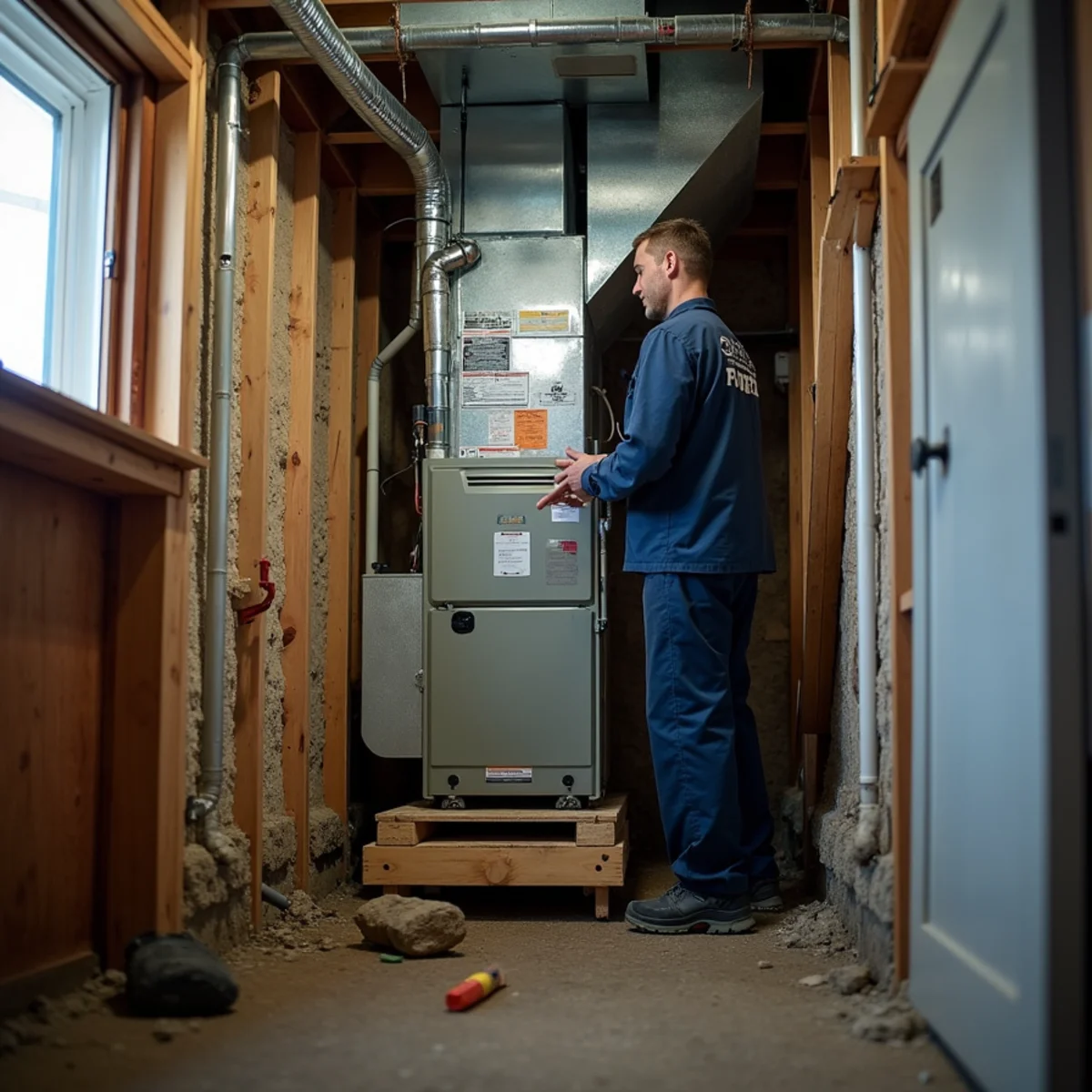
What flood-aware installation looks like
The additional cost during a planned replacement is modest. It is effectively impossible to add afterward without pulling the equipment back out.
- A raised platform putting the equipment above the documented historical high-water line for that specific property
- Electrical disconnects, controls, and any low-voltage components relocated up with the equipment
- Pumped condensate discharge rather than a floor drain that surcharges during high water
- A sealed, corrosion-resistant platform rather than untreated lumber
- Sump and backup power considerations reviewed alongside the mechanical work
- Ductwork transitions arranged so a flood does not fill the supply plenum
- Documented model and serial numbers, photographed and kept off-site for insurance
What to do immediately after water reaches equipment
- Do not attempt to start any equipment that has been submerged, even partially. Not the furnace, not the air handler, not the water heater.
- Shut off power at the breaker and gas at the appliance valve if it is safely reachable
- Photograph everything — the water line on the cabinet, the surrounding area, the data plates — before anything is moved or cleaned
- Understand that submerged gas valves, control boards, and blower motors are generally not restorable. Manufacturers explicitly say so, and drying them out is not a repair.
- Have a licensed technician evaluate before anything is energized. A flooded gas valve that appears to work is a genuine hazard.
- Start drying the space immediately — EPA guidance puts the window at roughly 24 to 48 hours before mold risk climbs
Insurance, stated plainly
Standard homeowners policies exclude flood. Entirely. If you are in a mapped flood zone near the Conodoguinet, separate flood insurance is the only route to a paid claim on equipment lost to high water.
Many people in these neighborhoods do not know this until it matters. It is worth confirming with your agent this week rather than after an event.
A sudden condensate line failure that floods a ceiling is a different category and is often covered as sudden accidental discharge. Creek water in the basement is not.
Where this applies around Carlisle
- North Middleton Township — the Conodoguinet loops across the township and the floodplain is broad
- East Pennsboro Township — where the creek meets the Susquehanna, with combined exposure
- Mount Holly Springs — along Mountain Creek, with its own documented flood history
- Monroe Township — the Yellow Breeches valley, plus a high water table generally
- Boiling Springs — Children’s Lake and the Yellow Breeches
- Riverfront sections of New Cumberland, Lemoyne, and Harrisburg
Finding out what applies to your own property
Flood risk is property-specific rather than street-specific, and two houses a hundred yards apart can sit in different zones. Before making decisions about equipment placement it is worth establishing what the record actually says about your address rather than what the neighbourhood is generally thought to be.
The federal flood maps are public and searchable by address, and they give you the zone designation and, where one has been determined, the base flood elevation for the area. Local records add the part maps do not capture: what actually happened here in living memory.
- Search the FEMA Flood Map Service Center by your address for the zone and any base flood elevation
- Ask the municipal office about historical high-water marks, which are often better local knowledge than the map
- Ask long-standing neighbours where water has reached, since events predate current mapping
- Check whether an elevation certificate exists for the property — it matters for insurance as well as placement
- Note that being outside a mapped high-risk zone is not the same as being at no risk
Ductwork floods too, and it is harder to put right
Attention after a flood focuses on the furnace, which is understandable because it is the expensive item. The ductwork is the part more often mishandled, and it can matter more for the health of the house afterwards.
Sheet metal ducts that took water can generally be cleaned and disinfected properly, provided they are opened up and dried thoroughly rather than simply left. Internally lined ducts and flexible duct are a different matter: the insulation absorbs contaminated water, cannot be reliably cleaned, and holds moisture that will support growth. Those runs need replacing.
The failure mode we see afterwards is a house where the furnace was replaced correctly and the affected duct was left in place, so the new equipment distributes the smell and the spores throughout the building every time it runs.
Related services and areas
Frequently asked questions
Generally no. Manufacturers are explicit that submerged gas valves, control boards, and motors should be replaced rather than dried and reused. A gas valve that appears to work after immersion is a genuine safety hazard. Have any submerged equipment evaluated by a licensed technician before it is energized.
Above the documented historical high-water line for your specific property, with margin. That is a property-specific number rather than a general rule — we look at flood mapping and, more usefully, the physical evidence in the basement, which usually tells the story clearly.
No. Standard homeowners policies exclude flood entirely. Separate flood insurance is required for coverage on equipment lost to rising water. This catches a lot of Conodoguinet-area homeowners by surprise, and it is worth confirming with your agent well before you need it.
Yes, and this catches a great many people. Standard homeowners policies exclude flood, which is rising surface water, and cover for it comes through a separate flood policy, generally via the National Flood Insurance Program or a private equivalent. The distinction that matters in a basement is the source: water entering because a creek rose is flood and excluded from the standard policy, whereas water from a burst pipe or a failed appliance is usually covered by it. There is also typically a waiting period before a new flood policy takes effect, so it is not something to arrange when rain is forecast.
It depends entirely on the construction. Bare sheet metal duct can be cleaned and disinfected effectively, because the surfaces are non-porous and can be dried. Duct with internal fibrous lining, and flexible duct with an insulated jacket, cannot be reliably decontaminated once floodwater has soaked the insulation, and industry guidance is to replace those sections. Floodwater is not clean water, so this is a health question rather than an aesthetic one. Any assessment that concludes all the ductwork can simply be wiped down deserves a second opinion.
It can help, and it is worth asking your insurer or agent directly rather than assuming either way. Elevating mechanical equipment above the base flood elevation is a recognised mitigation measure, and in some circumstances documented elevation of service equipment influences rating. Independent of any premium effect, it substantially reduces the loss you would otherwise claim for, which matters for your deductible, your claims history and how quickly you get your heat back. Keep the documentation and photographs of the elevation work, since that is what supports both a rating discussion and a future claim.
Talk to a licensed Carlisle technician
HVAC Carlisle PA has served Carlisle and Cumberland County since 2007. We test before we recommend, we put options in writing, and we answer the phone at 2 a.m.
HVAC Carlisle PA · 122 Beech St, Carlisle, PA 17013 · +1 (327) 210-5999