Medium priority service · Carlisle, PA
Commercial HVAC Services in Carlisle, PA
Commercial work in Carlisle covers a wider range than most towns its size. There are the storefronts around the Square with mismatched equipment added over decades, the professional offices along East High Street, the restaurants where make-up air and kitchen exhaust balance decides whether the dining room is livable, and the warehouse and distribution buildings that turned the US-11 corridor through Middlesex Township into the Miracle Mile.
Same-day emergency service across Cumberland County 4.9/5 from 214+ reviewsLicensed & insured
- 4.9 ★
- 214+ local reviews
- 18 yrs
- Serving Cumberland County
- 24/7
- Emergency dispatch
- 100%
- Satisfaction guarantee
What those buildings have in common is that downtime costs money by the hour. Our commercial approach is built around that: documented preventive maintenance so failures are found on a Tuesday morning instead of a Saturday dinner rush, and priority emergency response when something goes anyway.
We work with owners, tenants, and property managers, and we are comfortable with the split-responsibility questions that come with a triple-net lease.
Commercial issues we get called for
- A rooftop unit down with tenants or customers in the building
- A dining room that is negative-pressure — doors that pull hard, drafts, and smoke that will not clear
- Uneven conditioning between a front retail space and a back office on the same unit
- Refrigerated storage or a server closet losing cooling
- Utility costs climbing across a multi-unit property with no obvious cause
- Economizers stuck closed, so the building never uses free cooling in spring and fall
- Aging equipment across a portfolio with no replacement plan or budget
- Warehouse space where heating stratifies at the ceiling and nobody at floor level is warm
Recognise any of these? Do not wait for it to get worse.
Same-day emergency service across Cumberland County. Licensed technicians, 214+ local reviews, and written options before any work starts.
Rooftop units: repair, replace, or restore
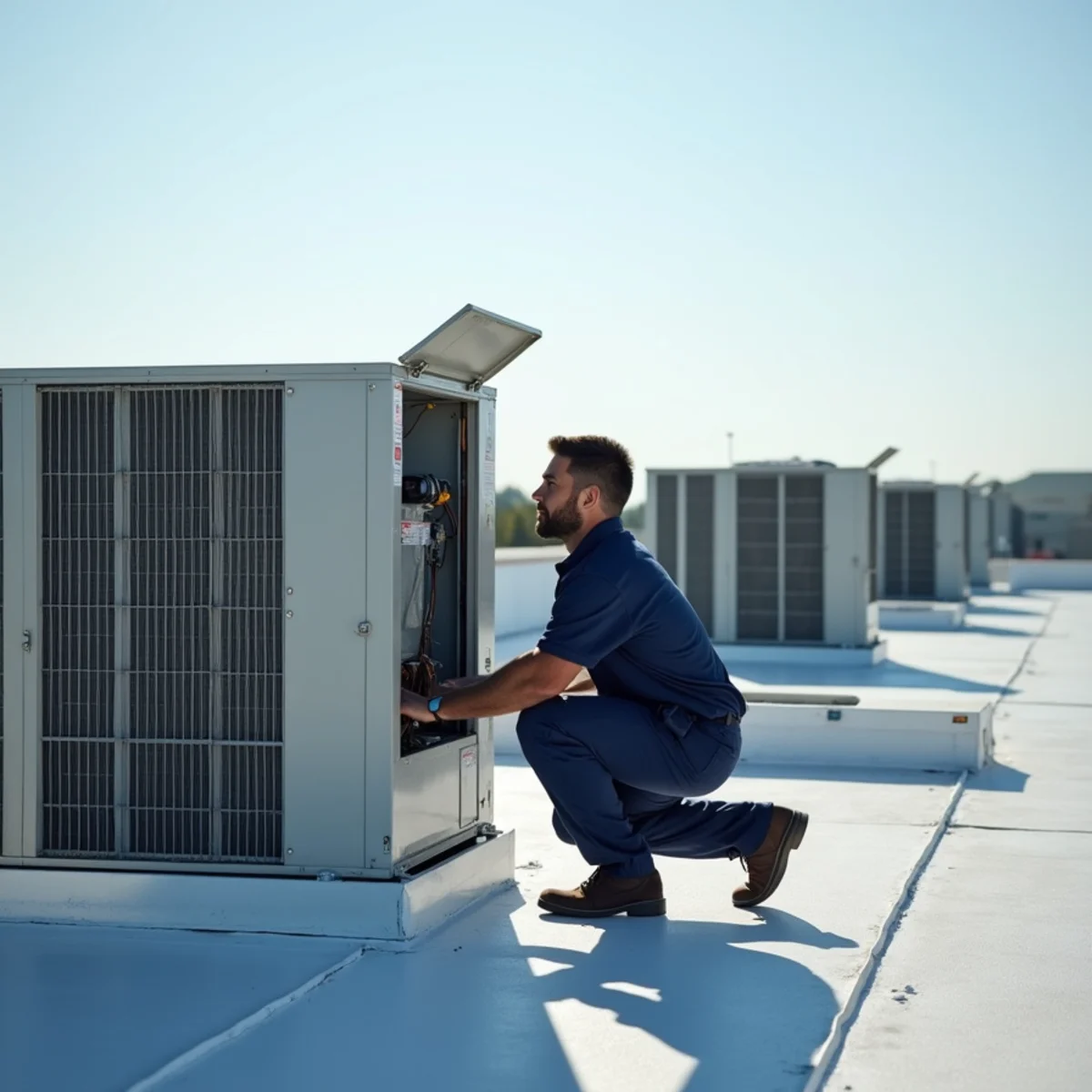
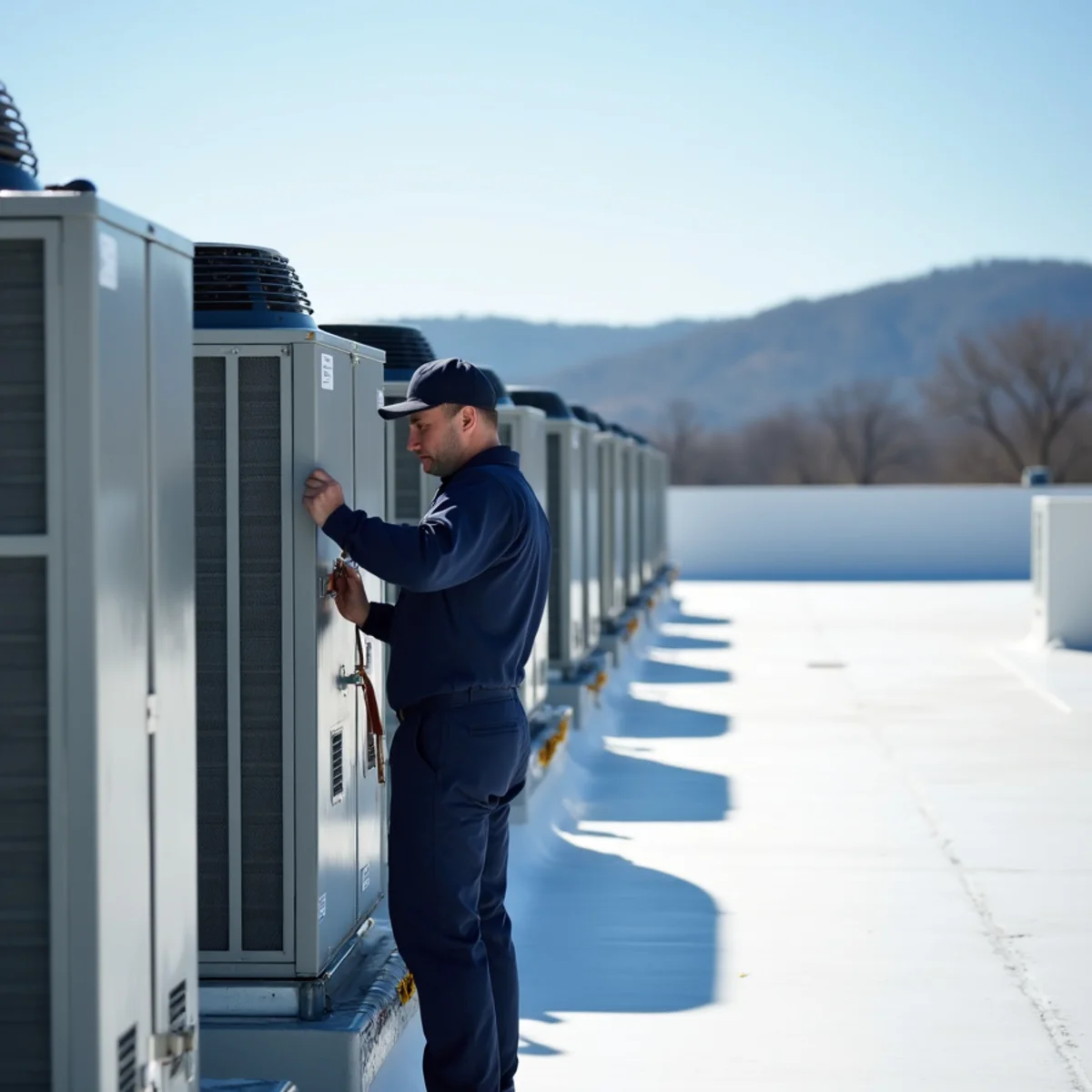
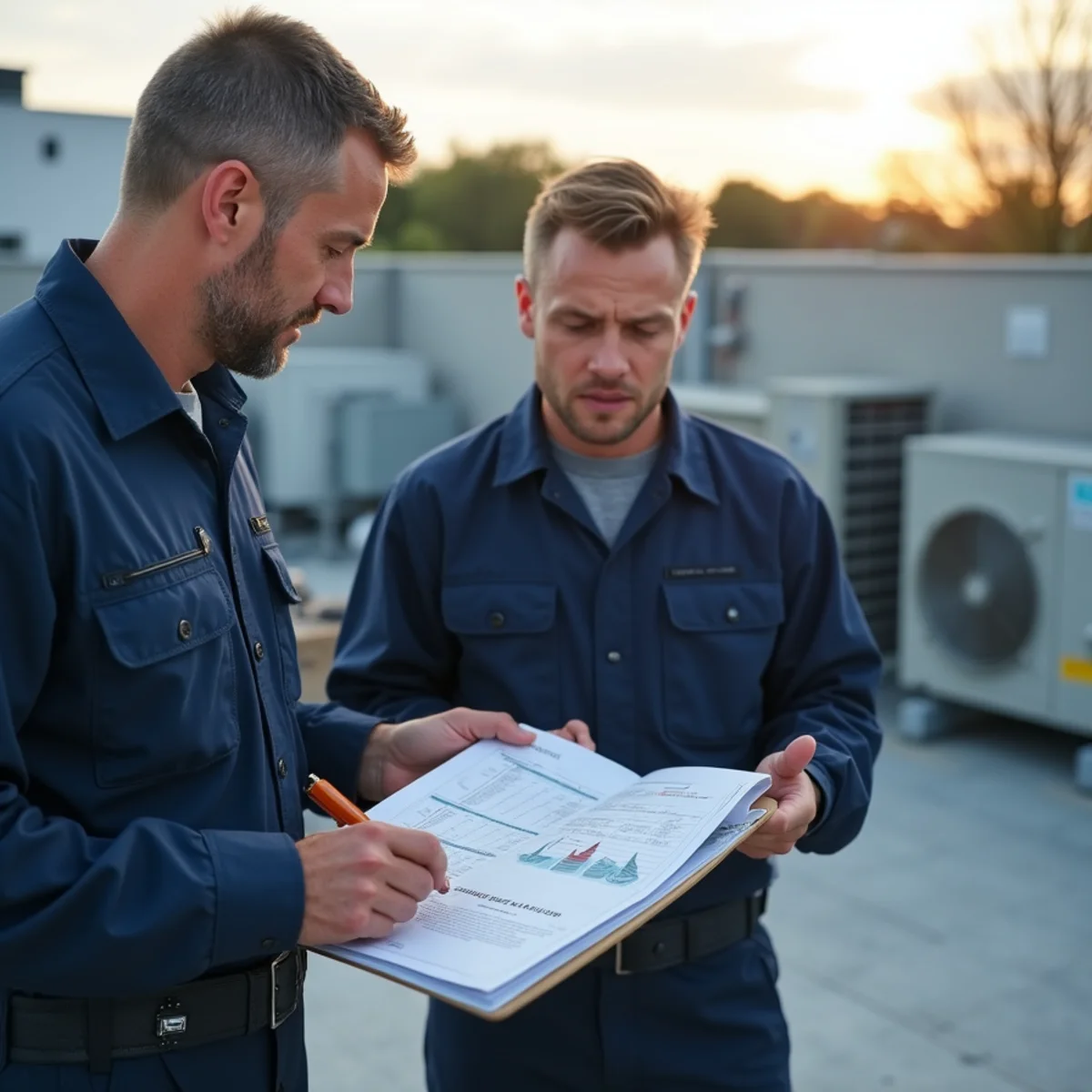
RTUs are the workhorse of commercial buildings around here, and they age in predictable ways: compressors, economizer linkages and actuators, belts and bearings, control boards, and a cabinet that eventually loses the fight with weather.
The repair-versus-replace decision on an RTU is more financial than technical. We look at remaining service life, energy performance against a current unit, curb compatibility, crane access and cost, refrigerant type, and whether the space it serves has changed since the unit was specified — a retail bay converted to an office has a completely different load.
Economizers deserve special mention. A stuck-closed economizer costs real money every spring and fall by running mechanical cooling when 55°F outdoor air would do the job for free. It is one of the highest-return commercial fixes there is, and it is found in a maintenance inspection, not by waiting for a failure.
Restaurants and building pressure
Kitchen exhaust hoods move an enormous volume of air. If make-up air does not replace it, the building goes negative: exterior doors become hard to open, cold drafts pour in through every gap, the dining room never holds temperature, and — the serious one — fuel-burning appliances can backdraft.
We measure building pressure, verify make-up air volume against hood exhaust, and balance the two. It is unglamorous work and it fixes complaints that owners have often been living with for years, assuming it was just how the building was.
Warehouse and distribution space
The warehouse boom along US-11 through Middlesex Township and out toward the Turnpike interchange built a lot of large-volume conditioned and semi-conditioned space, and heating that space is a stratification problem before it is a capacity problem.
Warm air rises to a thirty-foot ceiling and does nothing for people at floor level. Destratification fans, correct unit-heater placement and throw, and dock-door air management typically deliver more comfort per dollar than adding heating capacity.
We also handle the office pods inside those buildings, which are their own small systems and are frequently the ones generating the complaints.
Commercial maintenance contracts
- Scheduled quarterly or semi-annual visits with a written report per unit, tracked by asset tag
- Belt, bearing, filter, coil, drain, and economizer service on every visit
- Refrigerant and electrical readings logged, trended over time so degradation is visible
- Priority emergency dispatch ahead of non-contract customers
- Capital planning: an equipment inventory with age, condition, and projected replacement year for budgeting
- Optional after-hours scheduling so service does not interrupt trading hours
- Clear documentation for landlord/tenant cost allocation under a triple-net lease
The refrigerant phase-down and what it means for your capital plan
R-410A is being phased down under federal rules, and for a building owner that changes planning rather than operations. Existing equipment continues to run and can continue to be serviced, but the refrigerant it needs gets scarcer and more expensive across the remaining life of that equipment.
The practical consequence is that the arithmetic on an ageing rooftop unit with a chronic leak shifts each year. A repeated recharge that was an annoyance becomes a genuine operating cost, and the point at which replacement wins arrives sooner than a straight age-based schedule would suggest.
We factor that into the capital plan rather than leaving it as a surprise. Units with known leak histories get flagged earlier for replacement, and units that are sound get left alone rather than replaced pre-emptively on the strength of a headline.
Schedules, setbacks and the cost of running a building nobody is in
The cheapest energy in any commercial building is the energy not used conditioning empty space, and the most common finding on a first visit is a schedule that no longer matches how the building is occupied. Hours changed, a tenant moved, a shift pattern altered, and the controls kept running the pattern somebody set years ago.
Alongside that sit the overrides. A unit put into permanent occupied mode to resolve a complaint one afternoon and never returned, a setback disabled during a cold snap two winters ago, a sensor in a location that stopped being representative when a partition went in.
None of this requires capital. Reviewing schedules against actual occupancy, restoring setbacks and correcting overrides is a service visit, and on a building of any size it routinely returns more than the visit costs within a single billing period.
- Schedules checked against how the building is actually occupied now
- Overrides and permanent-occupied settings identified and returned
- Setback and setup temperatures restored where they were disabled
- Sensor locations reviewed after any partition or layout change
- Economizer operation verified, since a seized one runs cooling that was never needed
How we start with a commercial client
- 1
Site survey
Every unit inventoried — make, model, serial, age, refrigerant, condition, and what it serves.
- 2
Baseline testing
Electrical, refrigerant, airflow, and economizer function on each unit, recorded as a starting point.
- 3
Condition report
Immediate repairs, deferred items, and projected replacement year per unit, for your capital plan.
- 4
Contract scope
Visit frequency, what is included, what is excluded, response times, and after-hours terms — all in writing.
- 5
Scheduled service
Performed on the agreed cadence with a per-unit report after each visit.
- 6
Emergency coverage
Priority dispatch with your equipment history already in hand when we arrive.
What affects commercial pricing
We do not publish flat prices, because a price without a diagnosis is a guess. What we can do is tell you exactly what moves the number so you can compare quotes on scope rather than on a headline figure.
- Number, size, and type of units across the property
- Roof access — ladder, hatch, or crane requirements for larger work
- Visit frequency and whether after-hours scheduling is required
- Equipment age and refrigerant type across the portfolio
- Whether kitchen exhaust, make-up air, or refrigeration systems are in scope
- Response-time commitments written into the contract
- Multi-site portfolios, which we price as a program rather than per building
A note on the ranges we quote elsewhere on this site
Any dollar figures published here are Pennsylvania statewide planning proxies for budgeting purposes — not confirmed Carlisle quotes. Final pricing requires a site assessment, and we put every line item in writing before you approve anything.
Why Carlisle homeowners pick us for commercial hvac
Asset-tagged inventory
Every unit logged with make, model, serial, age, refrigerant and what it serves, so readings trend over time and degradation shows up before failure.
Economizers actually get checked
A stuck-closed economizer runs mechanical cooling through spring and fall while the building stays comfortable, so nobody reports it. It is the highest-return finding in commercial work and it only surfaces on inspection.
A capital plan you can budget from
Condition and projected replacement year per unit, so HVAC becomes a line item two or three years out instead of an emergency.
After-hours scheduling
Service outside trading hours so a maintenance visit never costs you a shift, plus priority emergency dispatch ahead of non-contract customers.
Schedules reviewed before capital is proposed
Overrides never returned and schedules matching a tenancy that ended are free to fix and routinely save more than the visit costs.
18 years serving Cumberland County · 214+ reviews · EPA Section 608 Universal certified technicians · NATE-certified service technicians · PA Home Improvement Contractor — registration number available on request · 100% satisfaction guarantee on every repair and installation
Where we provide commercial hvac
Our commercial work centres on two markets. The distribution buildings along the US-11 corridor through Middlesex Township — rooftop units, unit heaters, make-up air and the office pods inside them that generate most of the complaints.
The other is small commercial in the borough cores: storefronts around the Carlisle Square and along East High Street, professional offices, and restaurants where kitchen exhaust and make-up air balance decides whether the dining room is usable. We also serve Mechanicsburg, Camp Hill and the Shippensburg rental market.
Frequently asked: commercial hvac in Carlisle
Yes. Quarterly or semi-annual scheduled service with a written report per unit, asset-tagged tracking, trended readings, priority emergency dispatch, and a capital plan showing age and projected replacement year for each piece of equipment. We can schedule after hours so service never interrupts trading.
It is a financial decision more than a technical one. We weigh remaining service life, energy performance against current equipment, refrigerant type, curb compatibility, crane access cost, and whether the space it serves has changed since the unit was specified. We give you the numbers for both paths and the replacement year that makes budgeting sense.
The building is under negative pressure, almost always because kitchen exhaust is moving far more air than the make-up air system replaces. That also causes drafts, a dining room that will not hold temperature, and — the serious risk — the potential for fuel-burning appliances to backdraft. We measure building pressure and balance exhaust against make-up air.
Yes, including the distribution buildings through Middlesex Township and along the corridor toward the Turnpike interchange. Large-volume heating there is mostly a stratification and air-distribution problem, and we handle both the warehouse space and the office pods inside it — which are usually where the actual complaints come from.
Regularly. We are used to landlord/tenant split responsibility, triple-net cost allocation, work-order systems, COI requirements, and documentation that has to satisfy both parties. Tell us the reporting format your management platform needs and we will match it.
Not as a blanket policy, and be wary of anyone recommending that. Existing equipment can continue running and being serviced; what changes is the cost and availability of refrigerant over time. That matters enormously for a unit with a chronic leak and very little for a sound unit holding its charge. The sensible approach is to let leak history drive the replacement order within your capital plan: units that need recharging repeatedly move up the list, units that do not stay where they are. We tag and track that per unit so the plan rests on your actual equipment rather than on a general warning.
On a commercial unit the calculation includes things a residential one does not. Alongside repair cost against replacement cost and remaining service life, weigh the cost of downtime in that space, whether the unit still matches the load after any tenancy or layout change, refrigerant type and leak history, and whether the curb and structure suit a modern replacement. A unit that is oversized for a space repurposed years ago is a poor candidate for an expensive repair regardless of its age. We provide the per-unit history so those decisions are made from records rather than from the most recent invoice.
Related services
Often needed alongside commercial hvac
Maintenance
Documented seasonal tune-ups with actual readings — not a filter change and a sticker on the side of the unit.
Learn moreDuctwork
The duct system is where most comfort complaints actually live. We measure static pressure and fix the distribution.
Learn moreEmergency HVAC
One number, answered around the clock, with a real technician dispatched — not an answering service taking a message until Monday.
Learn moreFurther reading
Guides on this topic
- Rooftop Unit Repair vs. Replacement for Cumberland County BusinessesThe RTU decision is financial, not technical. Here are the six variables that actually decide it.
- Warehouse-Boom Carlisle: Commercial HVAC Along the US-11 Miracle MileWarm air at a thirty-foot ceiling does nothing for people on the floor. Here is what actually works.
Carlisle neighborhoods we serve
Need commercial hvac in Carlisle?
Same-day emergency service across Cumberland County. Call and speak to someone who can dispatch a licensed technician, or request a free written estimate and we will call you back.
214+ reviews · 18 years local · Licensed & insured · 100% satisfaction guarantee on every repair and installation
HVAC Carlisle PA122 Beech St, Carlisle, PA 17013
+1 (327) 210-5999