

Medium priority service · Carlisle, PA
Ductwork Repair & Installation in Carlisle, PA
Most of the comfort complaints we are called about are blamed on the furnace or the air conditioner. Most of them are actually the duct system.
Same-day emergency service across Cumberland County 4.9/5 from 214+ reviewsLicensed & insured
- 4.9 ★
- 214+ local reviews
- 18 yrs
- Serving Cumberland County
- 24/7
- Emergency dispatch
- 100%
- Satisfaction guarantee
That is not surprising in Carlisle. A large share of the borough’s ductwork was installed when a gravity octopus furnace was converted to forced air, sized by eye, and then asked to handle central air decades later — a job that needs substantially more airflow than heating ever did.
We measure static pressure on every diagnostic. It is a two-minute test that tells us instantly whether the equipment is fighting the ducts, and it is the single most informative reading in residential HVAC that most homeowners have never heard of.
Signs your ductwork is the problem
- Rooms at the ends of the system that never reach temperature in either season
- Strong airflow at registers near the furnace and almost none at the far ones
- The system is loud — whistling at registers or a roar at the return grille
- Dust accumulating fast, especially near supply registers
- A basement or crawlspace that is warm in winter and cool in summer, which means you are conditioning it by accident
- Filters that pull inward and bow when the blower starts
- Equipment that short-cycles or trips a limit switch with a clean filter installed
- Visible disconnected, crushed, or sagging flex duct

Recognise any of these? Do not wait for it to get worse.
Same-day emergency service across Cumberland County. Licensed technicians, 214+ local reviews, and written options before any work starts.
Static pressure: the reading that explains everything
Total external static pressure is a measure of how hard the blower has to work to push air through the duct system. Most residential equipment is rated for about 0.5 inches of water column. We routinely measure 0.9 to 1.2 in older Carlisle homes.
When static is that high, the blower cannot deliver its rated airflow. The result is coils that freeze in summer, limit trips in winter, rooms that never get air, motors that fail early, and equipment that never approaches its efficiency rating no matter how high the SEER2 number on the label was.
It is a two-minute test with a manometer and two probes. Any contractor quoting you replacement equipment without measuring it is guessing — and installing a better system into a duct problem produces a better-looking guess with the same complaints.
Return air is the usual culprit
In older Carlisle homes, supply ducts were often extended over the years as rooms were finished, but return air almost never was. You end up with a house that has plenty of places to push air into and one undersized central return trying to bring it all back.
The symptoms are unmistakable once you know them: doors that swing shut when the blower starts, a whistling gap under a closed bedroom door, a roaring return grille, and bedrooms that never hold temperature at night with the doors shut.
Adding returns — or, where that is impractical in a plaster house, transfer grilles and jumper ducts — is one of the highest-value comfort improvements available. It usually costs a fraction of new equipment and delivers more noticeable change.
Sealing, and where the leaks actually are
Duct leakage in a typical older home runs 20–30% of total airflow. In a basement that partly benefits you, since the leaked air stays inside the envelope. In an attic or a vented crawlspace it is money going directly outdoors.
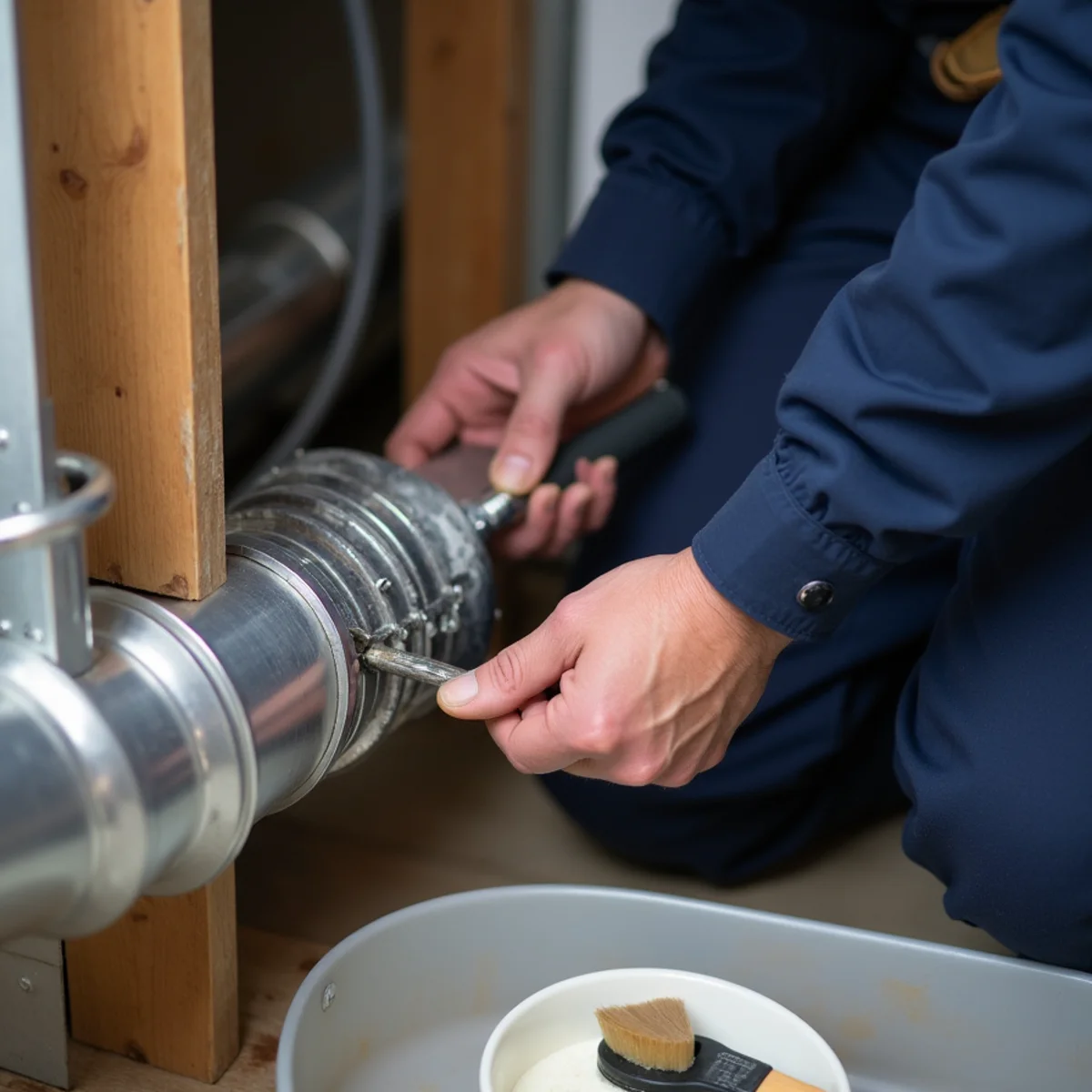
The leaks are almost never in the middle of a duct run. They are at the plenum joints, take-off collars, seams, boot connections to floor and wall registers, and the filter cabinet. Those are what we seal — with mastic and mesh, not cloth duct tape, which dries out and lets go within a few years.
- Supply and return plenum seams at the equipment
- Take-off collars where branches leave the trunk
- Longitudinal seams in older snap-lock pipe
- Boot-to-floor and boot-to-wall connections at every register
- Flex duct terminations, which are commonly held on by nothing but a zip tie and optimism
- The filter cabinet, which frequently draws basement or crawlspace air directly into the supply stream
When ducts need replacing, and duct cleaning honestly
Sometimes sealing is not enough. Crushed or disconnected flex, undersized trunk lines that cannot carry the required airflow, ducts in unconditioned attics with no insulation, or a fiberglass duct board system that has deteriorated internally are all replacement cases.
On duct cleaning, we will give you the honest version. It is genuinely worthwhile after a renovation, after rodent activity, if there is visible mold on interior duct surfaces, or if the system has never been cleaned in decades in a house with pets. It is not an annual necessity, and it will not fix an airflow or comfort problem. Anyone selling you an annual duct cleaning as routine maintenance is selling you something you do not need.
Why the shape of a duct system matters as much as its size
Air is lazy and it takes the easiest path. That single fact explains most of what goes wrong in residential duct systems: the register nearest the furnace gets more air than it needs, the run with three tight elbows and a long horizontal stretch gets almost none, and the room at the end of it is the one you called us about.
Fittings cost more pressure than length does. A sharp elbow, a poorly made takeoff at the trunk, or a flexible run pulled around a corner rather than supported in a gentle sweep can each cost more than many feet of straight duct. Systems assembled quickly are full of these, and none of them are visible as a fault.
That is why correcting distribution is frequently a matter of geometry rather than replacement. Improving takeoffs, easing the worst elbows, supporting flex properly so it is not throttled by its own sag, and sizing the trunk correctly at each stage delivers more than adding capacity upstream.
- Takeoffs at the trunk, which are the single most common restriction
- Flex duct supported in gentle sweeps rather than compressed around corners
- Trunk sized down progressively as branches leave it, so velocity stays sensible
- Elbows eased or replaced where the run has no room for a gentle turn
- Boots and register sizes matched to the airflow the room actually needs
Balancing: getting the right amount of air to each room
A duct system that is sealed and correctly shaped still has to be balanced, which means adjusting how much of the total airflow each room receives so that it matches what that room needs. Rooms differ: a west-facing bedroom under a roof needs more air in summer than an interior room of the same size, and a room over an unheated garage needs more in winter.
Balancing is done with dampers at the branches rather than by closing registers, which is what most people try first. Closing a register does not redirect air usefully; it raises system pressure and increases leakage from the ductwork before the air ever reaches another room.
We measure airflow at the registers rather than adjusting by feel, set the dampers, and mark them so they are not moved by accident. It is unglamorous work and it is frequently the difference between a system that performs and one that merely runs.
How duct work runs
- 1
Static pressure test
Total external static, plus pressure drop across the filter and coil individually, so we know where the restriction is.
- 2
Airflow measurement
Room by room at the registers, compared against the room-by-room load.
- 3
Visual inspection
Basement, crawlspace, and attic runs photographed, with disconnects and crushed sections documented.
- 4
Prioritized plan
Ranked by comfort gained per dollar — sealing and returns usually beat replacement.
- 5
Execute
Mastic sealing, added returns or transfer grilles, duct repair or replacement, and register balancing.
- 6
Re-measure
Static pressure and register airflow re-tested to confirm the change is real, not assumed.
What affects ductwork cost
We do not publish flat prices, because a price without a diagnosis is a guess. What we can do is tell you exactly what moves the number so you can compare quotes on scope rather than on a headline figure.
- Scope: targeted sealing versus adding returns versus a full distribution replacement
- Accessibility — an open basement is straightforward; a finished ceiling or a 30-inch crawlspace is not
- Whether new runs must be routed through finished space, which brings drywall and plaster repair
- Duct material: sheet metal fabrication versus insulated flex
- Insulation requirements for runs in attics and vented crawlspaces
- Number of registers, returns, and dampers involved
- Whether zoning equipment is part of the project
A note on the ranges we quote elsewhere on this site
Any dollar figures published here are Pennsylvania statewide planning proxies for budgeting purposes — not confirmed Carlisle quotes. Final pricing requires a site assessment, and we put every line item in writing before you approve anything.


Why Carlisle homeowners pick us for ductwork
Static pressure on every visit
A two-minute test that tells us instantly whether your equipment is fighting the ducts. Most residential gear is rated for about 0.5 inches of water column; we routinely measure 0.9 to 1.2 in older Carlisle homes.
Mastic, not tape
Cloth duct tape dries out and lets go within a few years. We seal plenums, collars, seams and boots with mastic and mesh so it holds.
Returns get added
Supply runs were extended over the decades in these houses; return air almost never was. Adding a return or a transfer grille is frequently the highest-value comfort improvement available.
Honest about duct cleaning
Worth doing after a renovation, after rodent activity, or with visible growth on interior surfaces. It is not annual maintenance and it will not fix an airflow problem, and anyone selling it that way is selling you something you do not need.
Balanced with a meter and marked dampers
Airflow measured at each register and dampers set and labelled, rather than adjusted by hand until the complaints stop.
18 years serving Cumberland County · 214+ reviews · EPA Section 608 Universal certified technicians · NATE-certified service technicians · PA Home Improvement Contractor — registration number available on request · 100% satisfaction guarantee on every repair and installation
Where we provide ductwork
Duct correction is the quiet fix behind most comfort complaints in the borough. Bellaire and Meeting House Heights are full of mid-century ranchers whose heating ducts were asked to carry cooling decades later, and the Army War College edge houses were converted from gravity systems entirely.
In the rural townships the finding is different but just as consistent: crawlspace runs with insulation that fell off years ago. We see it across Plainfield, West Pennsboro, Penn Township and out toward Biglerville, and it is among the cheapest genuine improvements available.
Frequently asked: ductwork in Carlisle
The clearest indicator is a static pressure test. Most residential equipment is rated for around 0.5 inches of water column; readings of 0.9 or higher mean the blower cannot deliver its rated airflow. Doors that swing when the blower starts, whistling registers, and rooms that never reach temperature are the symptoms that go with it.
Sometimes, and not annually. It is genuinely worthwhile after a renovation, after rodent activity, when there is visible mold on interior duct surfaces, or on a system that has never been cleaned in decades in a home with pets. It will not solve an airflow or comfort problem, and any company selling annual duct cleaning as routine maintenance is selling you something you do not need.
Pressure imbalance from insufficient return air. The supply is pushing air into the room faster than it can get back out to the return, so the room pressurizes. Beyond being annoying, it means that room is not getting the airflow it needs. Adding a return, a transfer grille, or a jumper duct fixes it.
It is possible but genuinely invasive in a plaster-walled historic home — you need chases for supply and return that usually do not exist, and creating them means opening walls and ceilings. In most of those houses a ductless mini-split system delivers better comfort with far less damage to the building, and we will recommend that even though it is a different product.
Targeted mastic sealing of accessible plenums, collars, seams, and boots in an open basement is one of the least expensive meaningful improvements in HVAC. Costs climb with limited access, attic or crawlspace work, and when insulation or replacement is needed. We quote after the static pressure test and inspection, and we tell you the expected improvement rather than promising a percentage.
It rarely works and it usually costs you something. Closing a register does not send that air somewhere more useful, it raises the pressure in the duct system, which increases how much air escapes through every leak upstream and makes the blower work harder. On some systems it can raise static pressure enough to affect equipment performance and life. Proper balancing happens at dampers in the branch runs, near the trunk, where the air can actually be redirected, and it is done with airflow measured rather than judged by hand at the grille.
In an older house with runs through unconditioned space it can be a substantial share, and it comes from two mechanisms: air escaping through unsealed joints and seams, and heat transferring through the duct wall where insulation is missing or has degraded. Both are worth addressing and sealing usually comes first because it is cheaper and the effect is immediate. We measure static pressure before and after so the improvement is a number rather than a claim, and the difference generally shows up as rooms that finally hold temperature rather than as a change on a bill you can point to.
Related services
Often needed alongside ductwork
Residential HVAC
Whole-house comfort work for Carlisle’s rowhomes, twins, ranchers, farmhouses, and new subdivisions — each treated differently.
Learn moreIndoor Air Quality
Humidity, filtration, and ventilation solved with measurements — starting with what your house actually reads.
Learn moreMaintenance
Documented seasonal tune-ups with actual readings — not a filter change and a sticker on the side of the unit.
Learn moreFurther reading
Guides on this topic
- Uneven Heat in Carlisle's Twins & Rowhomes: Ductwork Fixes That WorkThe answer is almost never a bigger furnace. It is usually a missing return, a crushed run, or a stairwell.
- Sizing HVAC for Carlisle's Older Homes: Why Rule-of-Thumb FailsSquare footage tells you almost nothing. Here is what actually determines the right size, and why it is usually smaller than what you have.
Carlisle neighborhoods we serve
Need ductwork in Carlisle?
Same-day emergency service across Cumberland County. Call and speak to someone who can dispatch a licensed technician, or request a free written estimate and we will call you back.
214+ reviews · 18 years local · Licensed & insured · 100% satisfaction guarantee on every repair and installation
HVAC Carlisle PA122 Beech St, Carlisle, PA 17013
+1 (327) 210-5999