Local Angles
Carlisle Historic District HVAC: Boiler and Radiator Care
These houses have been heated four different ways. Here is how to work with what they have instead of against it.
By HVAC Carlisle PAPublished Updated 9 min read

The Carlisle Historic District, listed on the National Register in 1979, radiates out from the Square with Federal, Greek Revival, Victorian, and Colonial Revival townhouses standing shoulder to shoulder.
Most of these houses have been heated four different ways: fireplaces, then coal, then oil, then gas. Each conversion left something behind, and the accumulated layers are what we work with today.
The recurring theme of this article is simple. In these houses, the existing system is usually better than what would replace it — it has just been mis-adjusted for decades.
Need this handled rather than explained?
Same-day emergency service across Cumberland County. Licensed technicians dispatched from Carlisle, with written options before any work begins.
Why radiators are genuinely good heat
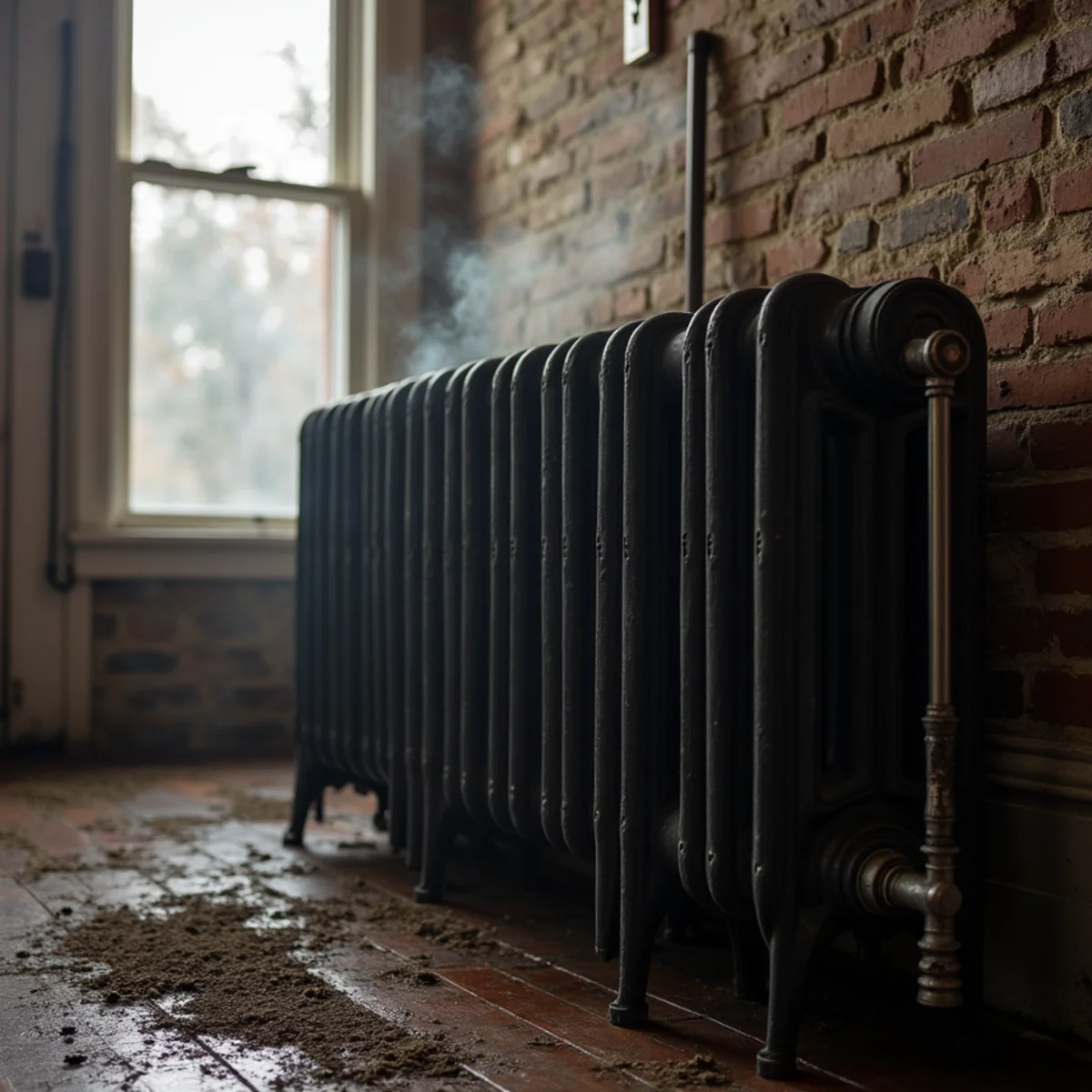
Cast-iron radiators heat primarily by radiation and gentle convection rather than by blowing air. That means no drafts, no dust circulation, no noise, and a very even temperature that suits high-ceilinged rooms with plaster walls.
They also have enormous thermal mass. Once warm, they keep releasing heat after the boiler shuts off, which smooths out temperature swings in a way forced air never does.
When a contractor proposes ripping out radiators to install ductwork in a Federal townhouse, they are proposing to permanently damage a building to install a system that will perform worse in it. We say that plainly.
The maintenance these systems actually need
- Annual combustion analysis and safety inspection on the boiler, with printed readings
- Expansion tank charge checked — a waterlogged tank is the number one cause of pressure complaints and relief valve discharge
- System pressure verified: roughly 12–15 psi cold for a two- or three-story house on hot water; ounces, not pounds, on one-pipe steam
- Radiator bleeding on hot-water systems, working from the lowest floor upward
- Radiator vent inspection on steam, replacing failures and graduating vent sizes by distance from the boiler
- Main vent inspection on steam — these fail silently and cause most of the problems people blame on the boiler
- Circulator and zone valve operation checked individually
- A look at near-boiler piping, especially if a previous contractor replaced the boiler
The one-pipe steam rebalance
If you have one-pipe steam and it bangs, or a radiator has been cold for years, this is the article section to read twice.
Steam is not pushed by a pump. It travels because it is under slight pressure and because air can leave the system ahead of it. Air vents are therefore the control system, and almost every problem traces back to them.
A typical failure sequence: the main vents die, so air cannot leave the mains quickly. Steam takes forever to reach the far radiators. Someone raises the pressuretrol to force it. Higher pressure makes venting worse and adds banging. Twenty years later, the house has a boiler replacement quote on the table.
The actual fix is an afternoon: new main vents, radiator vents graduated by distance so the near ones vent slowly and the far ones vent fast, pitch corrected on any radiator sitting wrong, and the pressuretrol dropped to where a one-pipe system belongs. Silent, even heat, on the same boiler.
Adding cooling without wrecking the house
These houses have no ductwork and no route for it. Running trunk lines means cutting chases through plaster and framing, which is expensive, disruptive, and permanently subtracts from a two-hundred-year-old building.
Ductless mini-splits are the answer, and head style matters more than most people realize.
- Floor-mounted consoles sit low like a radiator and read as appropriate in a period room — the option we recommend most often for principal rooms
- Concealed ducted heads hide entirely in a closet or knee wall and feed two or three rooms through short runs to slim ceiling registers. Nothing is visible but the register.
- Ceiling cassettes recess into a ceiling where there is accessible space above
- High-wall units are cheapest and most efficient but visually obvious — fine in a back bedroom, often wrong in a front parlor
Exterior work in a historic district
- Site condensers in side or rear yards, behind screening, and away from street-facing elevations
- Mount on risers rather than a slab at grade — meltwater and snow build ice shelves under grade-mounted units during freeze-thaw
- Run line sets in paintable line-hide along mortar lines or behind downspouts, where they are essentially invisible from the sidewalk
- Core-drill through mortar joints rather than through brick faces wherever possible
- Verify your property’s historic district review requirements for exterior equipment before installation, and get a placement plan you can actually submit
Winter humidity: protecting the house itself
This gets overlooked and it matters more in these houses than in any others we service.
January air at 21°F holds almost no moisture. Heat it to 70°F indoors and relative humidity can fall into the teens. Plaster, original trim, doors, floors, and furniture all lose moisture and shrink — joints open, plaster cracks, and hardwood gaps.
A properly sized humidifier controlled by an outdoor-reset humidistat brings the house into the 30–50% range EPA recommends, without fogging windows and creating condensation problems on single-glazed sash.
It is one of the few HVAC investments in a historic house that protects the building fabric rather than just the occupants.
Insulating an old house without trapping moisture in the walls
Solid masonry walls were built to handle water in a particular way: they absorb moisture and then dry outward and inward as conditions allow. That behaviour is why these buildings have lasted two centuries, and it is also why insulating them carelessly causes damage.
Adding insulation to the inside face of a solid wall makes that wall colder and slows its ability to dry inward. If warm indoor air can reach the cold surface behind the insulation, moisture condenses there, and the resulting damage happens invisibly inside the assembly rather than on a surface where you would notice.
The safe sequence is to start where the physics is uncomplicated. The attic plane offers the largest saving with the least risk, air sealing costs little and is entirely beneficial, and basement and rim joist work is straightforward. Interior wall insulation on solid masonry is specialist work worth taking advice on, not a weekend project.
- Attic insulation and air sealing first: biggest gain, lowest risk
- Rim joist and basement sealing next, which also helps the ground floor feel warmer
- Storm windows or careful draught-proofing before considering wall insulation
- Never seal a solid masonry wall so it cannot dry in at least one direction
- Keep indoor winter humidity controlled, since moisture you add ends up in the assembly
Before you remove anything original
The instinct on inheriting an old system is to modernise it, and in a historic house that instinct is frequently expensive in both directions: it costs money now and removes something that cannot be replaced.
Cast iron radiators are the clearest case. They are excellent heat emitters, they suit the buildings they were installed in, they are effectively unwearing, and their large surface area is precisely what makes a modern condensing boiler able to run efficiently at low water temperatures. Replacing them with undersized modern emitters removes that advantage.
The same caution applies to original windows, which can often be repaired and fitted with storms to perform comparably to replacements at lower cost, and to chimneys, which may be serving an appliance you have not considered. The reversible improvement is almost always the better first move in a building of this age.
Related services and areas
Frequently asked questions
In a historic Carlisle townhouse, almost certainly not. Radiators deliver excellent, even, draft-free heat that suits these buildings, and installing ductwork means cutting chases through plaster and framing. If cooling is the goal, ductless mini-splits give you that without touching the heating system or the walls.
Yes. Indoor humidity in the teens causes plaster to crack, trim joints to open, doors to shrink, and hardwood floors to gap. EPA recommends 30–50%. A properly sized and controlled humidifier addresses it, and in a historic house it protects the building fabric as much as your comfort.
Generally yes, but verify your property’s specific review requirements for exterior equipment before installation. Interior head placement is usually unrestricted; the outdoor unit and line-set routing are what attract review. We site condensers away from street elevations and run line sets in paintable covers along mortar lines, and we will provide a placement plan you can submit.
It can be done, and it needs doing carefully rather than enthusiastically. Solid walls dry by evaporation from both faces, and interior insulation makes the masonry colder while restricting inward drying, so any warm moist indoor air reaching the cold face condenses inside the assembly. Done properly it requires attention to vapour control, air sealing and detailing at floor and window junctions. Given the risk, it should come after the attic, air sealing and basement work, all of which give a larger return with essentially no moisture risk in a building of this type.
In a historic house they are frequently the better value and are sometimes the only option permitted. A well-fitted storm window over a repaired original achieves thermal performance broadly comparable to a standard replacement unit, at lower cost, while retaining original joinery and glass that cannot be reproduced. Replacements also have a finite life, whereas a repaired sash can continue for another century. Where the originals are genuinely beyond repair the calculation changes, but in a district with exterior review, storms are usually both the cheaper and the more straightforward route.
Look for a manufacturer name and pattern cast into the end section, which many nineteenth and early twentieth century makers included, and note the style of the sections and feet. Column radiators with decorative detailing are generally period; plain thin-tube units are typically later. Piping tells you as much: original one-pipe steam has a single connection at the bottom of each radiator with an air vent on the side, and hot water systems have connections at both ends. Any competent hydronic technician can date the system approximately on sight, and it is worth knowing before anyone proposes replacing it.
Talk to a licensed Carlisle technician
HVAC Carlisle PA has served Carlisle and Cumberland County since 2007. We test before we recommend, we put options in writing, and we answer the phone at 2 a.m.
HVAC Carlisle PA · 122 Beech St, Carlisle, PA 17013 · +1 (327) 210-5999