Cost & Insurance
Boiler Replacement Cost in Carlisle: The Repair vs. Replace Math
Good cast iron can run fifty years. Here is how to tell whether yours is worth keeping and what a real replacement includes.
By HVAC Carlisle PAPublished Updated 9 min read

Boiler replacement quotes in Carlisle vary more wildly than any other job we bid against, and the reason is almost always near-boiler piping. Two quotes for the same boiler can differ by thousands because one includes doing the piping correctly and the other does not.
Before any of that, though, there is a prior question: does your boiler actually need replacing?
Need this handled rather than explained?
Same-day emergency service across Cumberland County. Licensed technicians dispatched from Carlisle, with written options before any work begins.
Good cast iron is worth keeping
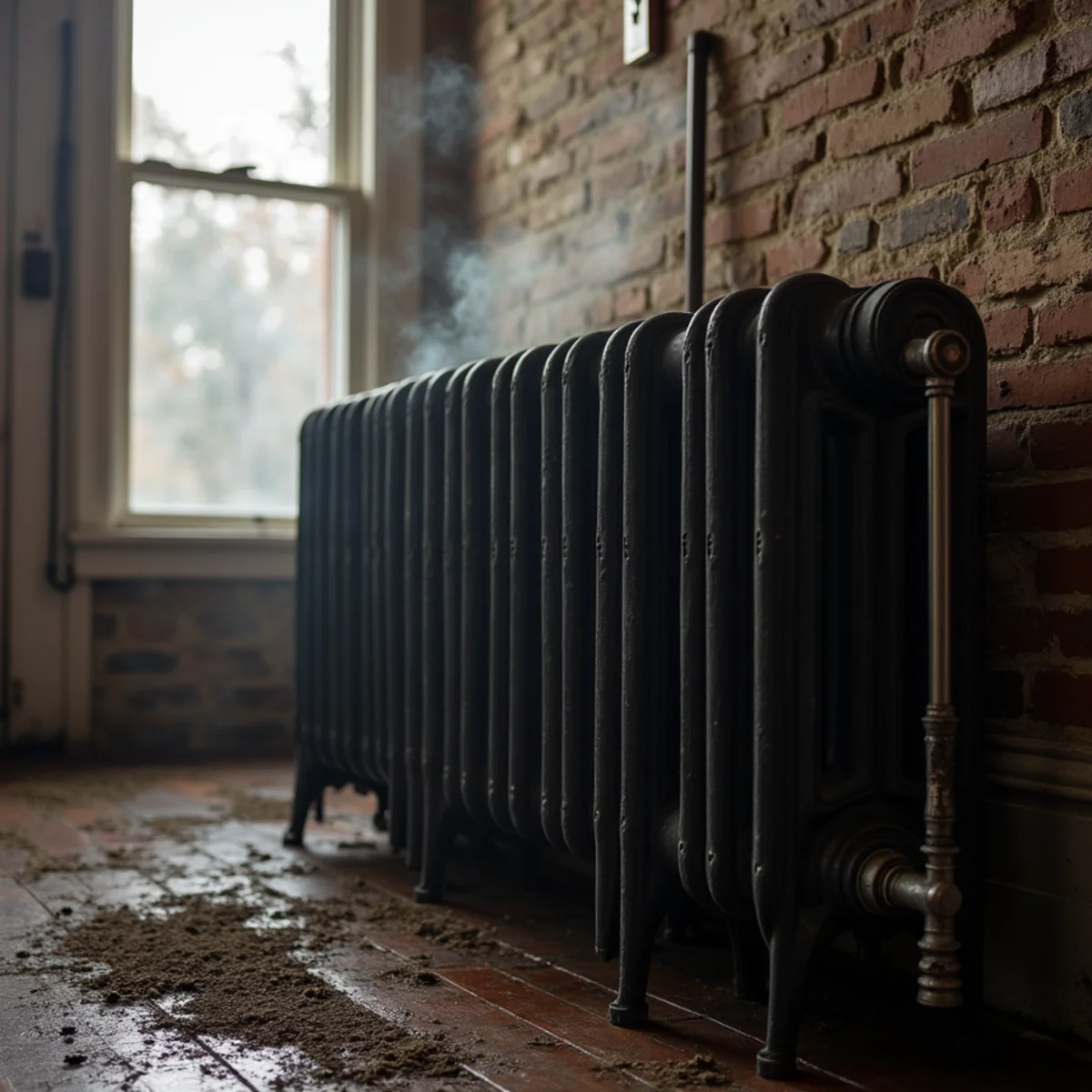
A well-maintained cast-iron sectional boiler can run fifty years. We service equipment in the Carlisle Historic District that is older than most of the contractors bidding to replace it.
What we evaluate: section integrity, weeping at the push nipples, flue and vent condition, and combustion efficiency measured with an analyzer. If the iron is sound and combustion is clean, the honest recommendation is to service it and tell you what to watch.
What genuinely justifies replacement: sections weeping or cracked, a compromised flue that cannot be corrected, combustion that cannot be brought into spec, or a repair cost approaching replacement on equipment with other measurable problems.
The problems people mistake for a failing boiler
Every one of those has cost customers a boiler replacement quote from someone. Every one is a repair.
- A cold radiator — usually air in the loop, a failed vent, or a zone valve, not the boiler
- Banging pipes — on steam, that is water hammer from pitch and venting; on hot water, trapped air
- Kettling, a rumble like a boiling kettle — scale on the heat exchanger, often addressable by flushing
- Pressure climbing and the relief valve discharging — almost always a waterlogged expansion tank
- One floor never heating — frequently a circulator installed pumping toward the expansion tank instead of away from it, which prevents the upper loops from purging
Condensing boilers: only where they can actually condense
A modern condensing boiler reaches its advertised efficiency only when return water temperatures stay low enough for the flue gas to condense. That requires emitters — radiators or baseboard — sized generously relative to the load, plus a properly configured outdoor reset curve.
Many Carlisle homes with original cast-iron radiators can achieve that. Those radiators were sized for high-temperature water in a leakier, less-insulated house; now that windows and insulation have improved, they are effectively oversized, which is exactly the condition a condensing boiler wants.
Some houses cannot get there, particularly those with fin-tube baseboard sized tightly to the load. In those, a condensing boiler runs in non-condensing mode most of the season and you have paid a premium for efficiency you never see. We measure before recommending.
Near-boiler piping: where cheap installs fail
The piping immediately around a boiler determines whether the system works. It handles air separation, flow direction relative to the expansion tank, primary-secondary decoupling on modern equipment, and correct circulator placement.
Done wrong, you get air that will not purge, uneven zones, short cycling, and premature failure — on brand new equipment. We have been called to correct near-boiler piping on boilers less than two years old more than once.
When comparing quotes, ask specifically what near-boiler piping is included and whether the existing piping is being reused. That single question explains most of the price gap.
What a complete boiler replacement includes
- Load calculation — most existing boilers in Carlisle are dramatically oversized
- Boiler selection matched to the emitters, not just to the old nameplate
- Complete near-boiler piping with proper air separation and circulator placement
- Expansion tank sized and charged for the system
- Venting: a correctly sized liner if staying on the chimney, or PVC if condensing
- Condensate drain and neutralizer on a condensing unit
- Zone valves or circulators, controls, and outdoor reset configuration
- Full system purge, radiator bleeding, and balance
- Permit, inspection, commissioning readings, and warranty registration
A note on steam
If you have a one-pipe steam system and someone has quoted you a replacement to fix banging or a cold radiator, get a second opinion first.
Those symptoms are almost always venting, pitch, and pressure — dead main vents, radiator vents that were never graduated by distance from the boiler, radiators pitched backward, and a pressuretrol turned up over the years chasing a cold room.
Rebalancing a one-pipe system is an afternoon of work and a fraction of a replacement. We do it regularly in the Historic District, and the results are frequently dramatic.
Chimney and venting: the line item that separates quotes
On a boiler replacement, the venting arrangement is frequently the largest cost difference between two quotations for the same appliance, and it is the one most often left out of the cheaper one.
An older atmospheric boiler vents into a masonry chimney sized for its flue gas volume and temperature. A modern sealed-combustion or condensing appliance produces far less, and much cooler, flue gas, which will not carry up an oversized masonry flue. It condenses on the way and damages the chimney.
So a replacement means either lining the chimney to a smaller correct size or venting through a sidewall in plastic pipe. Both are real work. There is also the water heater to consider: if it shared that chimney, removing the boiler leaves it orphaned in a flue far too large, which is a spillage risk that must be resolved in the same job.
Zoning now costs less than zoning later
If your house has ever had rooms that run hot while others run cold, a boiler replacement is the cheapest moment you will ever have to fix it. The system is drained, the near-boiler piping is being rebuilt anyway, and adding zone valves or a second circulator at that point is incremental rather than a separate project.
Doing it afterward means draining the system again, cutting into pipework that was just finished, and paying a second mobilisation. The same work can cost noticeably more as a standalone job than as part of the replacement.
It is worth asking for it as a priced option even if you are unsure, so the decision is made with the number in front of you rather than deferred by default.
Related services and areas
Frequently asked questions
A well-maintained cast-iron sectional boiler can run forty to fifty years or more. Modern condensing boilers with stainless or aluminum heat exchangers generally have a shorter expected life — often fifteen to twenty-five years — in exchange for higher efficiency. Neither number is a replacement trigger on its own; condition and combustion readings are.
It depends on your emitters. Condensing boilers hit their rated efficiency only at low return water temperatures, which requires radiators or baseboard generously sized relative to the load plus a properly configured outdoor reset. Many older Carlisle homes with original cast-iron radiators qualify well; some houses do not. It should be measured, not assumed.
Usually near-boiler piping. One contractor is repiping properly with correct air separation and circulator placement; the other is reusing the existing piping and hanging a new boiler on it. Ask both quotes what near-boiler piping is included. It is the question that explains the gap.
Not the boiler itself, which is necessarily a single job. What you can stage is the work around it. Zoning, radiator replacement, thermostatic valves and an indirect water heater can all be added later, though each costs more done separately than done during the replacement. What should not be staged is anything affecting safety or basic function: venting, the near-boiler piping, and the expansion and air management have to be right on day one. If a quotation proposes deferring any of those to save money now, that is a reason for concern rather than a payment plan.
Usually yes, and it is reasonable rather than padding. Circulators and expansion tanks have a service life considerably shorter than a cast iron boiler, so on a system old enough to need a new appliance they are typically near the end of theirs. More importantly, the new boiler may have different flow requirements than the old one, so the existing circulator may be the wrong size regardless of its condition. Reusing an ageing expansion tank is a particularly poor economy: when it fails, system pressure climbs, the relief valve discharges, and you are draining the system again.
It is worth pricing, because this is the moment it is cheapest to fit. An indirect cylinder is heated by the boiler rather than by its own burner, which means one appliance to maintain, one flue, and generally strong recovery. The arguments against are the space it takes and that it ties your hot water to the boiler, so a boiler fault leaves you without both. Where it particularly makes sense is a house where the existing gas water heater is also elderly, or one that was sharing the chimney and now needs resolving anyway. Ask for it as a separate line so you can see the actual difference.
Talk to a licensed Carlisle technician
HVAC Carlisle PA has served Carlisle and Cumberland County since 2007. We test before we recommend, we put options in writing, and we answer the phone at 2 a.m.
HVAC Carlisle PA · 122 Beech St, Carlisle, PA 17013 · +1 (327) 210-5999