Commercial & Property Managers
Commercial HVAC Maintenance for Carlisle Small Businesses
Downtime costs by the hour. Here is what a contract should contain and the one finding that usually pays for it outright.
By HVAC Carlisle PAPublished Updated 8 min read
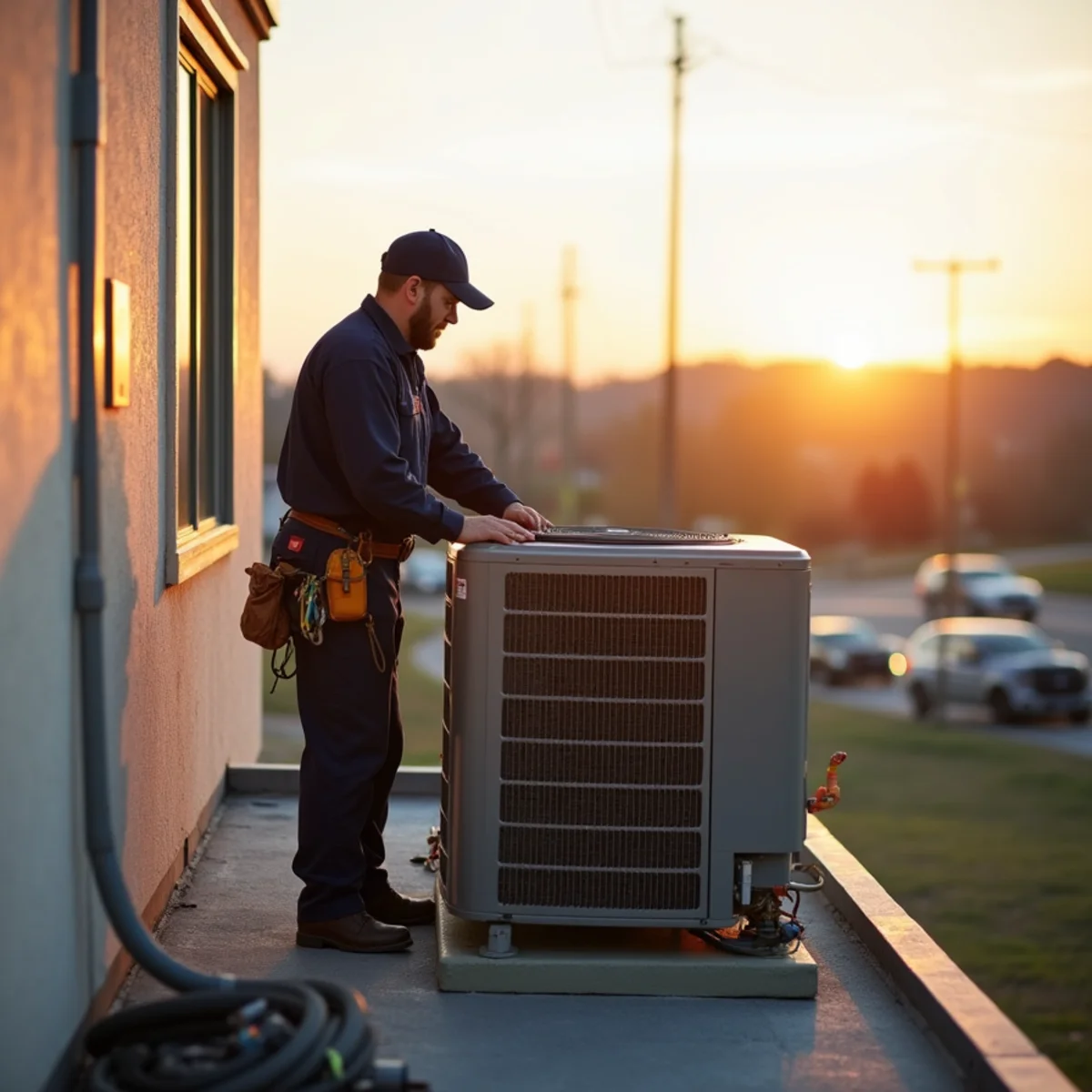
For a small business, an HVAC failure is not a comfort problem — it is a revenue problem. A restaurant that loses cooling on a Saturday in July loses a night. A retail space that is uncomfortable loses browsing time. A professional office loses productivity and reputation.
Scheduled maintenance exists to move failures from Saturday night to Tuesday morning, when they cost far less.
Need this handled rather than explained?
Same-day emergency service across Cumberland County. Licensed technicians dispatched from Carlisle, with written options before any work begins.
What a contract should include
- A full equipment inventory: make, model, serial, age, refrigerant type, and what each unit serves, tracked by asset tag
- Quarterly or semi-annual visits depending on equipment type and duty cycle
- A written report per unit after every visit, not one summary for the building
- Belts, bearings, filters, coils, drains, and economizer operation checked at each visit
- Electrical and refrigerant readings logged and trended over time
- Priority emergency dispatch ahead of non-contract customers
- A capital plan with condition and projected replacement year per unit
- After-hours scheduling so service does not interrupt trading
- Documentation formatted for landlord/tenant cost allocation if you are on a triple-net lease
The economizer finding that pays for the contract
Most commercial rooftop units have an economizer that brings in outdoor air for free cooling when conditions allow. In central Pennsylvania spring and fall there are a great many hours where 55°F outdoor air would cool your space for the cost of running a fan.
When the linkage seizes or the actuator fails, the damper stays shut and the unit runs mechanical cooling instead. Your building stays comfortable, so nobody reports anything, and the extra cost accumulates invisibly.
We found two seized economizers on a first inspection at a corridor facility. The repair cost a fraction of one month of the excess energy they had been paying without knowing it. This is the single most common high-value finding in commercial work, and it never surfaces without an inspection.
What fails on small commercial equipment, in order
- Belts — a broken belt takes a rooftop unit out completely and it is a ten-minute fix if caught worn
- Capacitors and contactors, same as residential but under heavier duty cycles
- Condenser coils fouled by rooftop debris, cottonwood, and kitchen exhaust grease
- Condensate drains, which on a rooftop unit back up into the cabinet and cause corrosion
- Economizer actuators and linkages, which fail silently
- Bearings on larger blower assemblies
- Control boards, particularly after a power event
Restaurants: the building pressure problem
Kitchen exhaust hoods move a very large volume of air. If make-up air does not replace it, the building goes negative — and that produces a specific set of symptoms owners often assume are just how their building is.
Exterior doors that pull hard to open. Cold drafts pouring in through every gap in winter. A dining room that never holds temperature. Smoke that will not clear.
The serious risk is that a negatively pressured building can cause fuel-burning appliances to backdraft, putting combustion products into the space.
Measuring building pressure and balancing make-up air against hood exhaust is unglamorous work that resolves complaints owners have lived with for years.
Storefronts around the Square and along East High
Downtown Carlisle retail has its own pattern. Many of these buildings are 19th-century structures with mechanical equipment added over decades — often several small units serving areas that have been reconfigured multiple times since.
Common findings: a unit serving a space that has been divided since it was installed, so one tenant freezes and another bakes. A thermostat in a back room that never reflects conditions at the front where the customers are. Front doors opening constantly in winter with no vestibule and no air curtain.
The fixes are usually zoning, thermostat relocation, and door management rather than new equipment. They are also cheap relative to what most owners expect.
Building the capital plan
The part of a maintenance contract small business owners value most, once they have it, is the capital plan.
Every unit gets an age, a condition assessment, and a projected replacement year. That turns HVAC from an unpredictable emergency expense into a line item you can budget for two or three years out.
It also changes the replacement conversation entirely. Replacing a unit on a planned schedule in October is a very different purchase than replacing one in a panic on the first 95°F Saturday of the summer — in price, in equipment selection, and in whether you had any choice about it.
Filters and belts: the unglamorous items behind most failures
Commercial equipment fails for less interesting reasons than people expect. Across small commercial sites, a large share of unplanned callouts trace back to two consumables that cost very little and are almost never on anybody schedule.
Filters in commercial units load faster than residential ones because the equipment moves more air for longer hours, frequently in dustier environments. A loaded filter reduces airflow, which in cooling ices the coil and in heating trips the limit, and both present as a unit that has stopped for no apparent reason.
Belts are the other one. A belt that is slipping is delivering less air than the unit is rated for, quietly, for months before it breaks. When it does break, it always does so at the least convenient moment, and the unit is producing nothing at all.
- Filter sizes and quantities recorded per unit, so ordering is not a research exercise
- Filter interval set from actual loading at your site, not from a generic schedule
- Belt tension checked at every visit and spares held on site for the common sizes
- Pulley alignment checked, since misalignment eats belts and nobody looks for it
- Condensate drains and pans cleared, a very common summer shutdown cause
- Coils cleaned on a schedule, because a fouled coil raises running cost silently
When the landlord and the tenant disagree about who pays
This is the most common non-technical problem on small commercial sites, and it delays repairs that both parties want done. The answer is in the lease rather than in custom, and the language varies far more than people assume.
Typical arrangements range from the tenant being responsible for routine maintenance while the landlord covers replacement, to full tenant responsibility, to full landlord responsibility with the cost recovered through service charges. Many leases also set a monetary threshold above which responsibility shifts.
The practical advice is to establish it before something breaks, not during. Read the maintenance and repair clauses, note any threshold, and confirm in writing who authorises work and up to what value. We are frequently asked to attend a site where nobody can approve a repair, and the building stays uncomfortable while that gets resolved.
Related services and areas
Frequently asked questions
Quarterly for equipment under heavy duty cycles — restaurants, buildings with extended hours, anything with kitchen exhaust — and semi-annually for lighter-use offices and retail. The right frequency depends on equipment type, runtime, and how much a failure costs you when it happens.
Usually, and the case is mostly about downtime rather than the maintenance itself. Priority dispatch, failures found on a Tuesday instead of a Saturday, and a capital plan that lets you budget for replacements all have concrete value. The economizer finding alone frequently pays for a year of the contract.
It depends entirely on your lease. Triple-net leases typically put maintenance and often replacement on the tenant; other structures split it, sometimes with a dollar threshold above which the landlord takes over. Read the clause before you need it, and keep documentation of every service visit — that documentation is what settles disputes.
Think in three parts rather than one number. First, planned maintenance, which is a predictable per-unit cost and the cheapest part. Second, a repair allowance, which for equipment in the middle of its life is modest and rises as it ages. Third, a capital sinking fund based on the remaining life of each unit, so a replacement is a planned purchase rather than an emergency. The last is the one small businesses skip, and it is why a rooftop unit failing in July so often becomes a crisis. Knowing the age and condition of each unit is what makes any of this estimable.
Some of it, sensibly. Filter changes on accessible units, keeping the area around equipment clear, keeping outdoor coils free of debris and litter, and reporting changes in noise or performance promptly are all reasonable in-house tasks and genuinely reduce failures. What should not be in-house is anything requiring the electrical supply to be isolated, roof access without proper arrangements, refrigerant work, which requires certification, or combustion adjustment. A good arrangement is that your staff handle the consumables between visits and the contractor handles the instrumented work, with both recorded in the same log.
Per unit rather than per building: identification and location, make, model, serial and tonnage, refrigerant type, installation date, every service visit with the readings taken, every repair with its cost, and the filter and belt sizes. That set answers almost every question that arises later, including whether to repair or replace, what to budget next year, and whether a recurring fault is actually recurring. Keep it somewhere that survives staff changes. The single most common problem we meet on a first commercial visit is that nobody currently employed knows what is on the roof.
Talk to a licensed Carlisle technician
HVAC Carlisle PA has served Carlisle and Cumberland County since 2007. We test before we recommend, we put options in writing, and we answer the phone at 2 a.m.
HVAC Carlisle PA · 122 Beech St, Carlisle, PA 17013 · +1 (327) 210-5999