Local Angles
Warehouse-Boom Carlisle: Commercial HVAC on the US-11 Miracle Mile
Warm air at a thirty-foot ceiling does nothing for people on the floor. Here is what actually works.
By HVAC Carlisle PAPublished Updated 8 min read
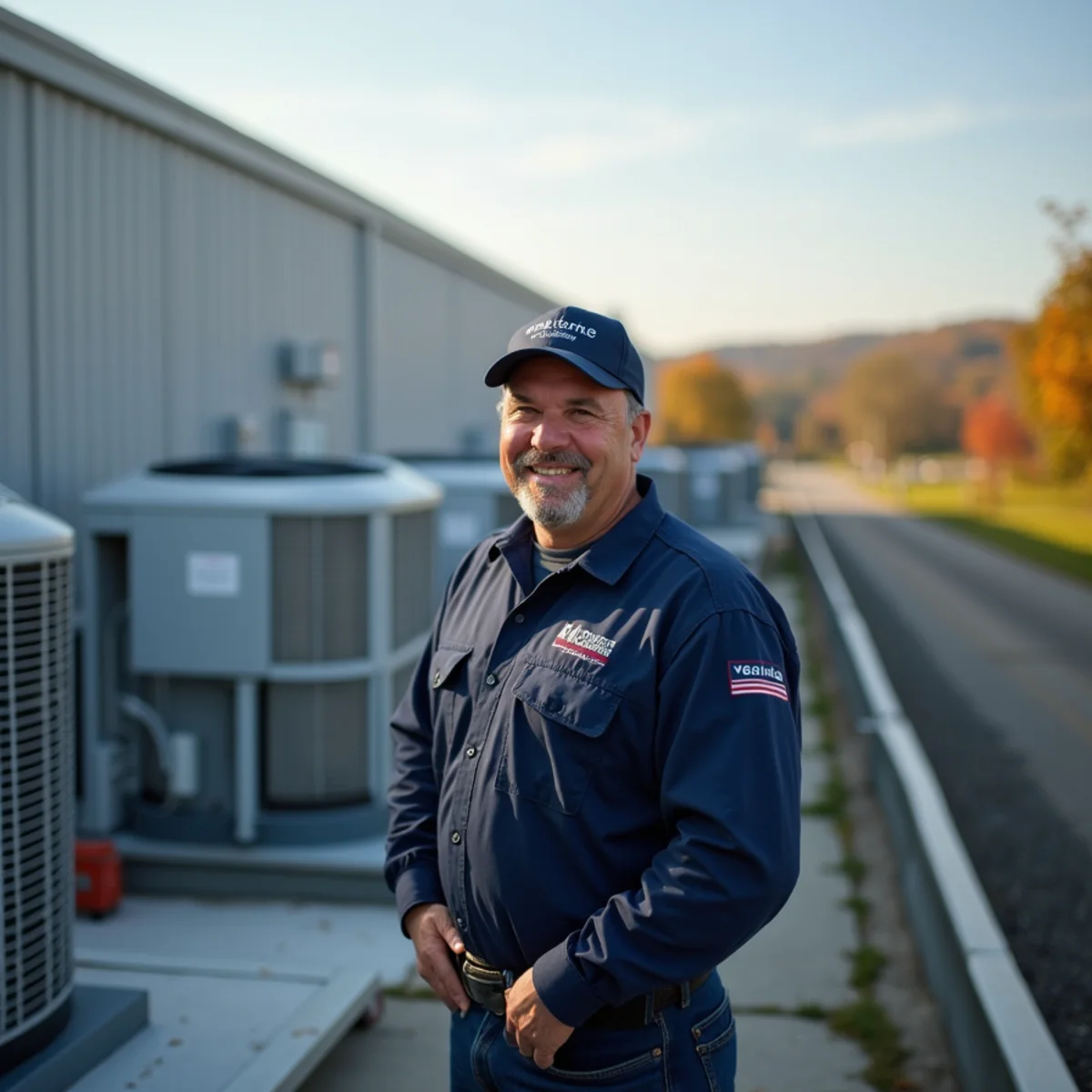
The stretch of US-11 through Middlesex Township that locals call the Miracle Mile turned farmland into one of the mid-Atlantic’s busiest distribution corridors, and it did so because of geography: I-81, the Pennsylvania Turnpike, and US-11 converge within a few miles.
Conditioning those buildings is a genuinely different discipline from residential work, and most of the money in it is not spent where owners expect.
Need this handled rather than explained?
Same-day emergency service across Cumberland County. Licensed technicians dispatched from Carlisle, with written options before any work begins.
Stratification: the warehouse heating problem
Warm air rises. In a building with a thirty-foot ceiling, that means the heat you paid for collects in the top ten feet where nobody works, while people on the floor stay cold.
The instinct is to add heating capacity. All that does is put more warm air at the ceiling, faster, at greater cost.
The actual solutions are about air movement and delivery, not capacity: destratification fans that push ceiling air back down, unit heaters positioned and aimed so their throw reaches occupied level, and radiant heating that warms surfaces and people directly rather than heating the air volume at all.
For a genuinely tall building, radiant is frequently the most cost-effective approach, because it sidesteps the stratification problem entirely.
Dock doors and building pressure
- Every open dock door is a hole in the building envelope large enough to erase a heating system’s output
- Air curtains at active doors substantially reduce infiltration when properly sized and aimed
- Vestibules and dock seals limit exchange during loading
- Building pressure matters — exhaust fans running against open doors accelerate the loss
- Operational scheduling helps more than equipment: staging loading so doors are open in shorter windows saves real money
The office pods are where the complaints come from
Nearly every complaint we receive on a distribution building originates in the office area, not the warehouse floor.
Those pods are usually served by a small residential-style split system that has to condition a space with glass on one exterior side and warehouse temperatures on the other. The load is uneven, the thermostat is in one office, and everybody else is either too hot or too cold.
Zoning helps. So does relocating the thermostat somewhere representative and adding a return where the pod has none. These are small, inexpensive interventions that resolve the complaints an entire facility team has been fielding for years.
Economizers: the highest-return commercial fix there is
A rooftop unit’s economizer brings in outdoor air for free cooling when conditions allow. In central Pennsylvania spring and fall, there are a great many hours where 55°F outdoor air would cool a building for the cost of running a fan.
When the economizer linkage seizes or the actuator fails, the damper stays closed and the unit runs mechanical cooling instead. The building stays comfortable, so nobody complains, and the extra cost accumulates invisibly month after month.
We found two seized economizers on the first inspection at a corridor facility, and the repair cost a fraction of one month of the excess energy they had been paying. It is the single best reason to have commercial equipment inspected on a schedule rather than waiting for a failure.
What a commercial maintenance program should include
- Every unit inventoried by asset tag: make, model, serial, age, refrigerant type, and what it serves
- Quarterly or semi-annual visits with a written report per unit
- Belts, bearings, filters, coils, drains, and economizer operation checked on every visit
- Electrical and refrigerant readings logged and trended, so degradation is visible before failure
- Priority emergency dispatch ahead of non-contract customers
- A capital plan with projected replacement year per unit, so budgets are not built on surprises
- After-hours scheduling so service does not interrupt operations
- Documentation formatted for landlord/tenant cost allocation under a triple-net lease
Rooftop unit repair versus replacement
The RTU decision is financial more than technical. What we weigh: remaining expected service life, energy performance against current equipment, refrigerant type and its availability, curb compatibility for a changeout, crane access and cost, and whether the space it serves has changed since the unit was specified.
That last point catches people out. A retail bay converted to office space, or a warehouse section converted to conditioned storage, has a completely different load than the unit was sized for — and no amount of maintenance makes a mis-matched unit perform well.
For a portfolio, the right answer is usually a planned replacement schedule rather than reactive replacement. That is what the capital plan is for.
Building a replacement schedule from asset data rather than from failures
Facilities that budget well for mechanical equipment do one thing that facilities in constant crisis do not: they hold a register of what they own and what condition it is in, and they replace from that rather than from whatever failed most recently.
A rooftop unit that fails in July gets replaced in July, at emergency pricing, with whatever equipment is available rather than what suits the load. The same unit replaced from a plan gets specified properly, procured at a normal price and installed at a convenient time.
The register does not need to be elaborate. Per-unit identification, age, refrigerant type, leak and repair history, and a condition rating updated at each maintenance visit is enough to rank the estate and forecast several years of capital with reasonable confidence.
- Every unit tagged and identified, with make, model, serial, tonnage and refrigerant
- Age and expected remaining life, revised at each service rather than set once
- Repair history and cost per unit, which identifies the money pits quickly
- Leak history specifically, since refrigerant availability is tightening under the phase-down
- A condition rating updated at each visit, so the ranking reflects reality
- The area each unit serves, because a repurposed space may no longer match its equipment
Scheduling work in a facility that cannot stop
Distribution operations run long hours and some run continuously, which makes access the constraint on almost every job. Pretending otherwise produces plans that collapse on the day.
Most work in an operating facility falls into three categories: work that can proceed alongside normal operations, work needing a defined area cleared for a shift, and work requiring a genuine shutdown. Establishing which category a job falls into at quotation, rather than on arrival, is what keeps a project on schedule.
Rooftop work is frequently the easiest to schedule because most of it happens above the operation rather than in it, provided roof access and any required permits are arranged in advance. The work that genuinely needs floor space, such as replacing distribution or ductwork over racking, is what needs planning around a shutdown window.
Related services and areas
Frequently asked questions
Stratification. Warm air rises to the ceiling of a high-bay space and stays there. Adding heating capacity puts more warm air at the ceiling rather than at floor level. Destratification fans, correct unit-heater placement and throw, or radiant heating that warms surfaces directly are the effective approaches.
Have the economizers checked. A stuck-closed economizer runs mechanical cooling through spring and fall when free outdoor air would do the job, and it produces no comfort complaint — so nobody reports it. It is the highest-return finding we make on commercial equipment and it only turns up on inspection.
Yes. Asset-tagged inventory, quarterly or semi-annual scheduled service with per-unit written reports, trended readings, priority emergency dispatch, after-hours scheduling, and a capital plan with projected replacement years for budgeting. We can format documentation to match your management platform or lease cost-allocation requirements.
All of them, and the more useful question is how often each is visited. A sensible contract differentiates by criticality rather than covering some units and ignoring others: a unit serving a server room or a temperature-sensitive area warrants more frequent attention than one serving a storage mezzanine. Two visits a year is a common baseline for rooftop equipment, before cooling and before heating, with additional visits for critical units. What matters more than the frequency is that each visit produces recorded readings per unit rather than a tick against the building.
Enough to make a capital decision without going up on the roof. That means per-unit identification and location, make, model, serial, tonnage and refrigerant type; installation date and estimated remaining life; a full repair history with costs; leak history; filter and belt sizes so ordering is not a research exercise; and the area each unit serves. Add a condition rating updated at each visit and you can rank the whole estate at any time. Most facilities discover the register itself pays for the effort the first time a unit fails and nobody has to work out what it was.
A good deal of it, yes, and that should be established at quotation rather than assumed either way. Rooftop maintenance, most repairs, economizer work and filter and belt changes generally proceed above and around normal operations given roof access arranged in advance. Work requiring floor space beneath racking, ductwork modification over an active line, or anything needing the electrical supply isolated is different and needs a planned window. The failure mode is a contractor who does not raise the distinction until the day, which turns a scheduled job into a stoppage nobody budgeted for.
Talk to a licensed Carlisle technician
HVAC Carlisle PA has served Carlisle and Cumberland County since 2007. We test before we recommend, we put options in writing, and we answer the phone at 2 a.m.
HVAC Carlisle PA · 122 Beech St, Carlisle, PA 17013 · +1 (327) 210-5999