Commercial & Property Managers
Rooftop Unit Repair vs. Replacement for Cumberland County Businesses
The RTU decision is financial, not technical. Here are the six variables that actually decide it.
By HVAC Carlisle PAPublished Updated 8 min read
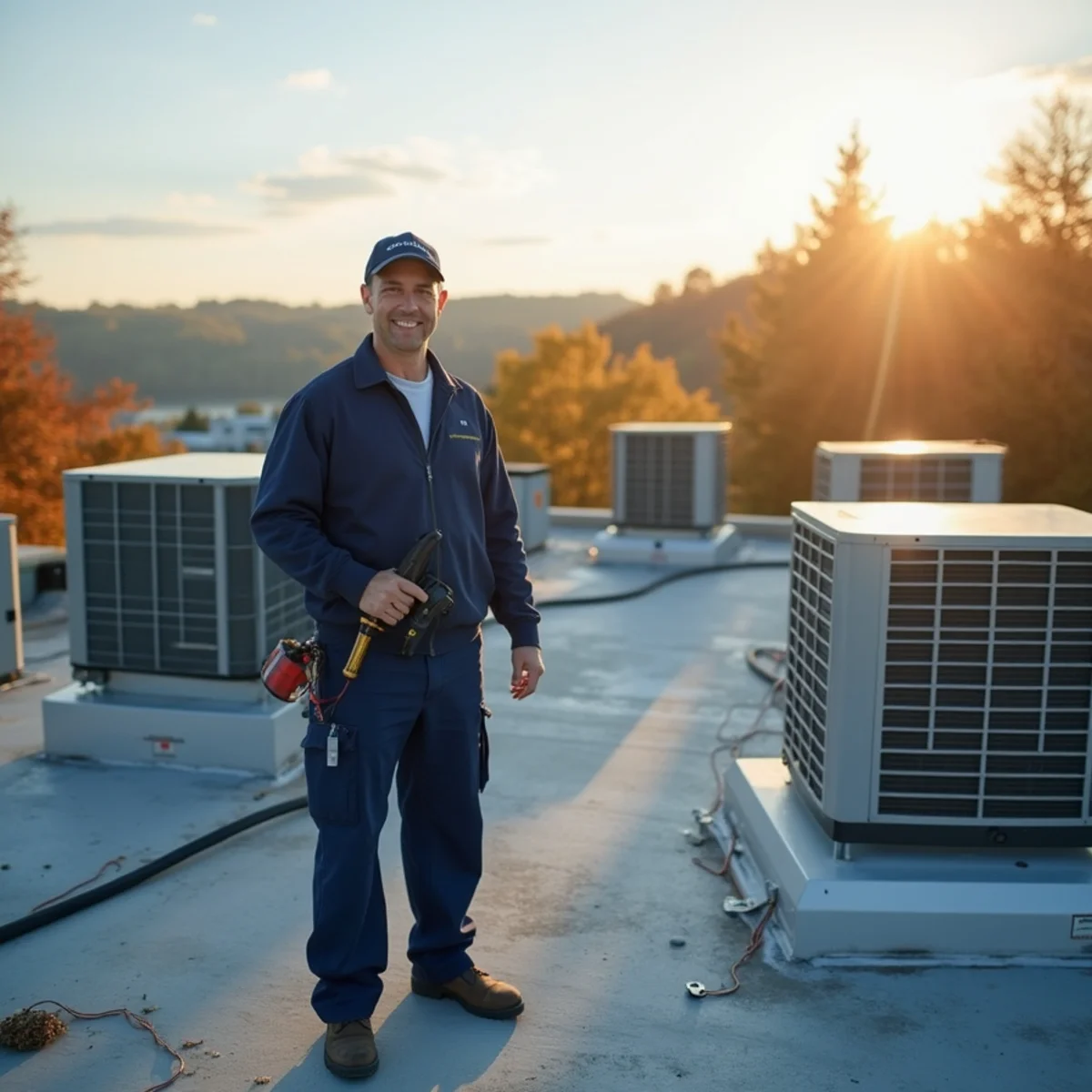
Rooftop units are the workhorses of commercial buildings across Cumberland County, and the repair-versus-replace decision on one is a financial question wearing a technical costume.
Six variables decide it, and only two of them are about the unit itself.
Need this handled rather than explained?
Same-day emergency service across Cumberland County. Licensed technicians dispatched from Carlisle, with written options before any work begins.
Variable one: remaining service life
Commercial rooftop units generally have a shorter expected life than residential equipment because they sit fully exposed to weather and typically run longer hours.
What matters more than age is condition: cabinet integrity and corrosion, coil condition, compressor performance, and the maintenance history. A well-maintained unit in a sheltered rooftop position outlasts a neglected one in a wind-exposed corner by years.
A unit with a badly corroded cabinet is finished regardless of what the compressor is doing, because water is getting into places it should not.
Variable two: what the space has become
This is the one that catches owners out. A unit sized for a retail bay does not fit an office conversion. A warehouse section converted to conditioned storage has a different load than the open space it replaced. A restaurant that added a hood changed the building’s air balance entirely.
If the space has changed since the unit was specified, no amount of maintenance makes it perform correctly — it is solving the wrong problem well.
Replacement is an opportunity to size for what the space actually is now, and it frequently means a different capacity than what is up there.
Variable three: refrigerant
Refrigerant transitions have real financial consequences on commercial equipment.
R-22 systems are the clearest case: no longer produced, with reclaimed supply expensive and shrinking. A significant leak repair on an R-22 rooftop unit is usually money better spent toward replacement.
R-410A equipment is subject to an ongoing phase-down under HFC regulations, which affects long-term refrigerant availability and cost. It does not make an R-410A unit obsolete today, but it belongs in a fifteen-year capital plan.
Ask your contractor what refrigerant each unit uses and factor it into the replacement timeline for the portfolio.
Variable four: crane and access cost
This is the cost that surprises people, and it does not scale with the unit.
Replacing a rooftop unit generally means a crane. That cost depends on street access, the building’s surroundings, whether a road or parking area has to be closed, and how far the boom has to reach — and it is substantially the same whether you are lifting one unit or the smallest unit on the roof.
The practical implication: if you have several aging units and one fails, price replacing two or three in the same crane visit. The marginal cost of the additional units is far lower than doing them separately in successive years.
This is exactly the kind of decision a capital plan exists to enable.
Variable five: curb compatibility
- A new unit that matches the existing curb footprint installs far more cheaply than one that does not
- A mismatch requires a curb adapter, which adds cost and can create a weak point for roof leaks if done poorly
- Different manufacturers use different footprints, so staying within a family sometimes saves real money
- Duct connection locations matter too — a unit with supply and return in different positions means rework inside
- Any curb work should involve the roofing contractor, because the roof warranty is at stake
Variable six: energy performance
A twenty-year-old rooftop unit is dramatically less efficient than current equipment, and on a unit running long hours in a commercial building that difference is a real annual number rather than a rounding error.
Factor in also that a new unit will have a functioning economizer, which is frequently not true of the old one. Free cooling through spring and fall in central Pennsylvania is worth a meaningful share of the annual cooling spend.
The honest way to evaluate this is to compare projected annual operating cost between the existing unit and a replacement, over the replacement’s expected life, against the capital cost. That calculation sometimes favors replacing a unit that is still working.
Getting quotes you can actually compare
Rooftop replacement quotes are notoriously difficult to compare because the scope varies so much and the expensive items are the ones easiest to leave out. The crane is the classic example: a quote without it looks substantially cheaper until installation day.
Insist that every quote addresses the same defined scope, and that anything excluded is stated as an exclusion rather than simply omitted. That single discipline usually explains most of the spread between bids.
- Crane or lift: included, and for how long — this is frequently the largest single line
- Curb adapter or new curb, and who verifies the existing curb is suitable
- Structural review where the replacement is heavier than the outgoing unit
- Electrical: does the existing supply and disconnect suit the new unit
- Controls integration with any existing building management system
- Removal, disposal and refrigerant recovery of the old unit
- Permit, inspection, commissioning readings and warranty registration
- Roofing work and flashing where the curb is disturbed, and who warrants the roof afterwards
What installation day actually involves
A rooftop changeout is a bigger logistical exercise than an equivalent piece of residential work, and most of the risk is in the hour either side of the lift rather than in the mechanical connection.
The crane needs somewhere to set up, which means a clear area with adequate ground bearing, often in a car park that has to be closed, and it may need permissions if any part of the operation is over a road or a neighbouring property. Weather can stop a lift entirely, so a contingency date matters.
Expect the space served by the unit to be without conditioning for the working day. For most retail and office spaces that is manageable if scheduled sensibly; for anything temperature-sensitive it needs planning, and temporary equipment should be discussed at quotation rather than on the morning.
Related services and areas
Frequently asked questions
Expected service life is shorter than residential equipment because of full weather exposure and longer runtime. Condition matters more than age — cabinet integrity, coil condition, compressor performance, and maintenance history. A well-maintained unit substantially outlasts a neglected one of the same vintage.
Often yes, if several are aging. The crane and access cost is largely the same for one unit as for three, so the marginal cost of additional units in the same visit is much lower than replacing them in successive years. It is one of the strongest arguments for having a capital plan rather than replacing reactively.
It does not make existing R-410A equipment obsolete today, but it affects long-term refrigerant availability and cost, and it belongs in your planning horizon for units you expect to keep another decade or more. Ask your contractor what refrigerant each unit uses and build that into the replacement schedule.
A straightforward like-for-like changeout on a suitable existing curb is typically a single day, with the lift itself occupying a small part of it and the connection, commissioning and testing taking the rest. What extends it is a curb that needs adapting or replacing, electrical work, roofing repairs where the old curb is disturbed, or controls integration. Weather is the other variable, since a crane lift will not proceed in high wind. Ask for the realistic scenario and the contingency plan rather than the best case, and confirm what happens to the space if the job runs over.
If the replacement is heavier than the outgoing unit, or if the curb or roof structure is of unknown condition or age, yes, and it is not an expensive step relative to the risk. Modern equipment is not always heavier, but higher-efficiency units are sometimes larger and heavier than what they replace, and the roof structure was designed for a specific load. A contractor who dismisses the question entirely on a building of any age is worth questioning. Where a structural engineer is needed it should appear in the quotation, not arrive as a surprise.
Frequently yes, and it is worth asking, particularly for retail or food premises where a day without conditioning is a day of lost trade. The constraints are practical rather than absolute: crane operations at night need lighting and may need permissions, some municipalities restrict noise and road closures by hour, and out-of-hours labour costs more. For many businesses the premium is smaller than the trading loss it avoids. Raise it at quotation so it is priced properly rather than negotiated after a schedule has been set around normal hours.
Talk to a licensed Carlisle technician
HVAC Carlisle PA has served Carlisle and Cumberland County since 2007. We test before we recommend, we put options in writing, and we answer the phone at 2 a.m.
HVAC Carlisle PA · 122 Beech St, Carlisle, PA 17013 · +1 (327) 210-5999