Local Angles
South Mountain Microclimates: Heating Differences Within 10 Miles
A house at Gardners and a house on Beech Street are ten miles and one climate zone apart.
By HVAC Carlisle PAPublished Updated 8 min read
We set dual-fuel switchover points differently for houses two miles apart. That is not fussiness — it is a response to real differences in what those houses experience.
Within ten miles of the Carlisle Square you can find the valley floor, foothill slopes, mountain gaps, and genuine mountain elevation at Michaux State Forest. Each behaves differently in winter.
Need this handled rather than explained?
Same-day emergency service across Cumberland County. Licensed technicians dispatched from Carlisle, with written options before any work begins.
The valley floor
Carlisle Borough, Middlesex Township, and the flat ground along the Conodoguinet sit at the bottom of the bowl. This is where cold air pools on clear, calm nights.
These locations experience the coldest overnight minimums in the area under inversion conditions, but the least wind exposure. Design implication: size for a genuinely cold design temperature, and protect condensate lines aggressively because clear-night pooling is exactly what freezes them.
The foothill slopes
The rising ground toward South Mountain in South Middleton, and toward Blue Mountain up Waggoners Gap Road in North Middleton, behaves counterintuitively.
On inversion nights these slopes can sit above the pooled cold air and actually run warmer than the valley floor below them. On windy nights they run colder because of exposure.
Design implication: exposure and infiltration matter more than absolute elevation here. Air sealing pays back better on a slope house than almost anywhere else, and the balance point calculation should account for wind-driven load rather than just temperature.
The gaps
Mount Holly Springs sits where Mountain Creek cuts through South Mountain. Waggoners Gap does the same on the Blue Mountain side.
Gaps funnel wind. A house in a gap experiences substantially higher wind speeds than one a mile away on flat ground, and wind drives infiltration load directly — a leaky house in a gap loses heat far faster than the same house elsewhere.
Design implication: air sealing and window condition matter enormously. So does chimney draft — wind-induced downdraft is a real cause of pressure switch trips and combustion problems in gap locations, and it is worth checking specifically.
Mountain elevation
Gardners, the Michaux State Forest edge, and the Pine Grove Furnace area sit at genuine elevation. Temperatures run consistently colder than the valley, snow accumulates more and lasts longer, and roads clear later.
Design implication: a heat pump sized against valley-floor design temperatures will be short of capacity here on the coldest nights. Backup heat needs to be real, and for seasonally occupied cabins, freeze protection with remote monitoring is not optional.
Access matters too. When we schedule work up there in winter we plan around road conditions rather than assuming a thirty-minute drive.
What this means practically
- Ask what design temperature was used for your load calculation, and whether it reflects your specific site rather than a regional average
- On dual-fuel, expect the switchover point to differ from your friend’s five miles away — and have it revisited after the first winter of actual operation
- On slope and gap properties, prioritize air sealing before adding capacity. Infiltration is a larger share of your load than it is on the valley floor.
- At elevation, verify heat pump capacity at 5°F, not just at 47°F, and confirm the backup heat can genuinely carry the house
- In gaps, have chimney draft checked specifically — wind-induced downdraft causes real combustion problems
- On the valley floor, protect condensate lines as a matter of course
Why generic HVAC advice fails here
National guidance treats "central Pennsylvania" as one climate. It is not, and within our service area the variation over ten miles is larger than the variation between many neighboring states.
A contractor who applies one design temperature and one switchover setting across everything from Lemoyne to Gardners is going to be wrong for most of those houses in one direction or the other.
This is a real argument for local knowledge over a bigger service footprint. Knowing that Waggoners Gap runs differently than the creek bottom two miles away is not exotic expertise — it is just paying attention to the place you work.
Snow, access and where equipment should sit at each elevation
The elevation differences that change your design temperature also change the practical details of installation, and those get overlooked more often than the sizing does.
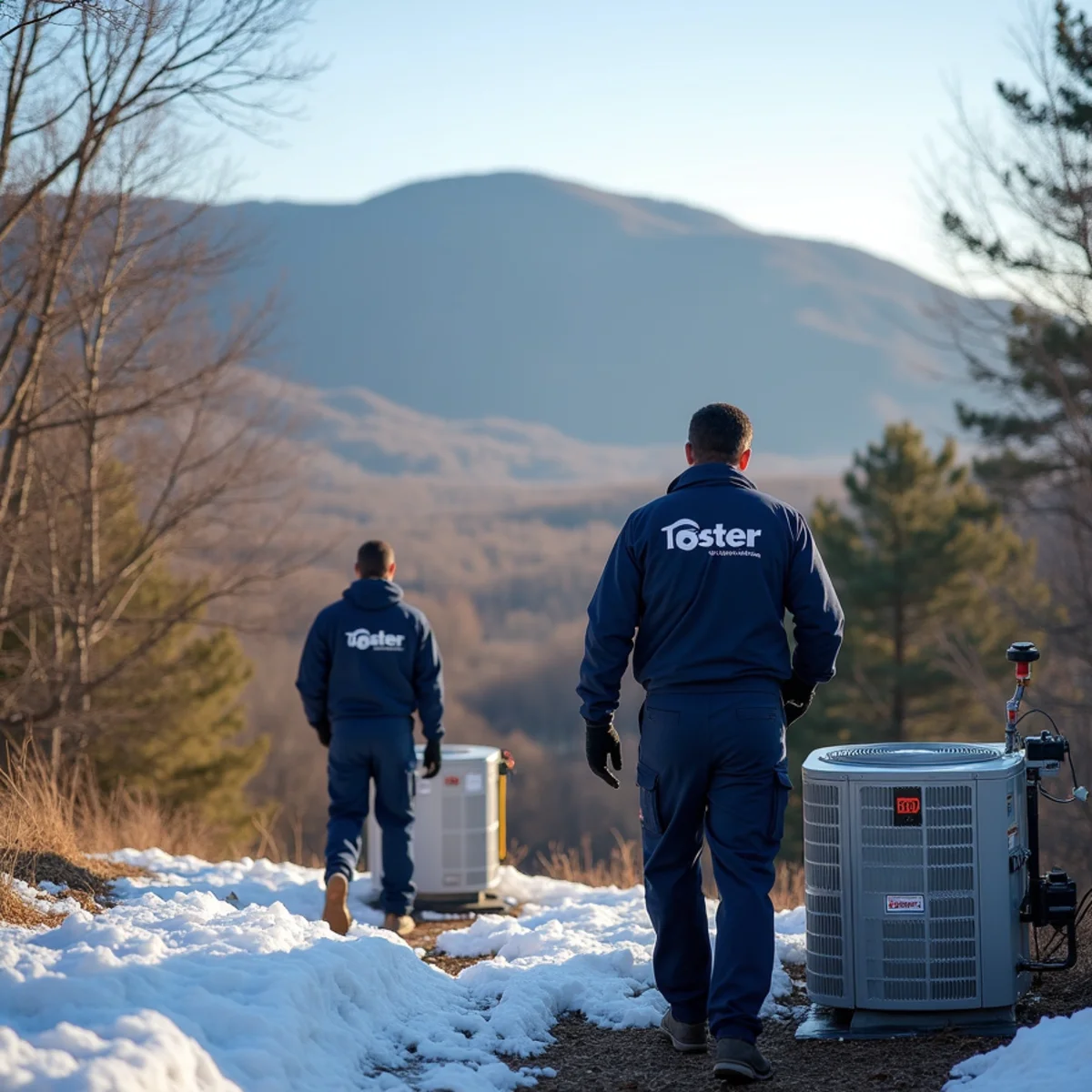
Snow depth and drifting increase as you climb, which affects how high an outdoor unit needs to sit. A heat pump mounted at valley height on the mountain side can end up buried, and a buried unit cannot breathe, cannot defrost properly and will ice into a solid block.
Access changes too. Long unpaved driveways and steep approaches determine whether a service vehicle reaches a property in February, which is an argument for both redundancy in the heating and for scheduled maintenance ahead of winter rather than reactive calls during it.
- Raise outdoor units well above expected local snow depth, on a proper stand rather than a pad
- Keep roof and gutter discharge away from any outdoor unit, since runoff freezes into a block
- Plan clearance for drifting on the windward side, not just uniform depth
- Consider fuel storage capacity, because deliveries stop when the roads ice
- Favour a system with backup heat where access is genuinely difficult in winter
Fuel availability changes with elevation too
The practical consequence of climbing away from the boroughs is that natural gas mains thin out and then stop. On the valley floor a conversion may be a straightforward option; on the foothill slopes and up toward the mountain it is generally not available at any sensible cost.
That is why heating decisions up here are between propane, oil, electric and combinations of those, and why the comparison should always be run from your own delivery tickets rather than a published average. Delivered fuel is priced per gallon at the moment of delivery, so a colder season is an extra delivery rather than a slightly larger monthly bill.
It is also why dual-fuel comes up so often as the recommendation at elevation. It uses the heat pump through the large mild majority of the season, retains a fuel-burning appliance for the coldest nights and for outages, and does not require the electrical service headroom that an all-electric installation with resistance backup would.
Related services and areas
Frequently asked questions
Within ten miles of Carlisle, yes — meaningfully. The differences come from cold-air pooling on the valley floor, wind exposure on slopes and in gaps, and genuinely colder temperatures at mountain elevation. Those affect design temperature, balance point, backup heat sizing, and how much air sealing is worth.
Ask, and ask them to justify it. A load calculation is only as good as its assumptions, and the design temperature is the most consequential one. A contractor who cannot tell you the number they used has not performed a real calculation.
Yes, with an honest design. Cold-climate heat pumps hold usable capacity well below freezing and will cover most of your season. What matters at elevation is that the balance point is calculated against your actual conditions and that backup heat — ideally an existing furnace in dual-fuel configuration — can genuinely carry the house on the coldest nights.
Elevation is the practical proxy and you can check it in a minute on any mapping service that shows terrain, or on a topographic map. What matters more than a label is the difference between your elevation and the nearest weather record used for design, plus your exposure: a property on an open slope facing the prevailing wind behaves like somewhere colder than its elevation alone suggests. A contractor sizing equipment for you should be able to say which design temperature they used and why, and that answer should reflect your site rather than the county.
Not because of elevation as such, but the calculation often lands differently. Outages tend to last longer where lines run through wooded terrain and access for repair crews is slower, so capacity to run for an extended period matters more than peak wattage. What drives the size is the type of heat: a furnace or boiler needs relatively little power for its controls and blower or pump, whereas electric resistance backup needs a great deal. That is one of the practical arguments for keeping a fuel-burning appliance in the system at elevation.
It does, and generally in your favour. Higher ground runs cooler than the valley floor in summer, particularly overnight, so the cooling load is lower and the overnight recovery is better. The practical effect is that properties at elevation often need less cooling capacity than an equivalent house in town, and are better candidates for approaches that rely on good night-time recovery. What does not change is the humidity question: sizing for moisture removal rather than for temperature alone still matters, and an oversized system will still leave a house cool and damp.
Talk to a licensed Carlisle technician
HVAC Carlisle PA has served Carlisle and Cumberland County since 2007. We test before we recommend, we put options in writing, and we answer the phone at 2 a.m.
HVAC Carlisle PA · 122 Beech St, Carlisle, PA 17013 · +1 (327) 210-5999