Commercial & Property Managers
A Landlord’s Guide to HVAC in Carlisle Rental Properties
The three practices that cut emergency calls across a rental portfolio, and the one that prevents a five-figure loss.
By HVAC Carlisle PAPublished Updated 8 min read
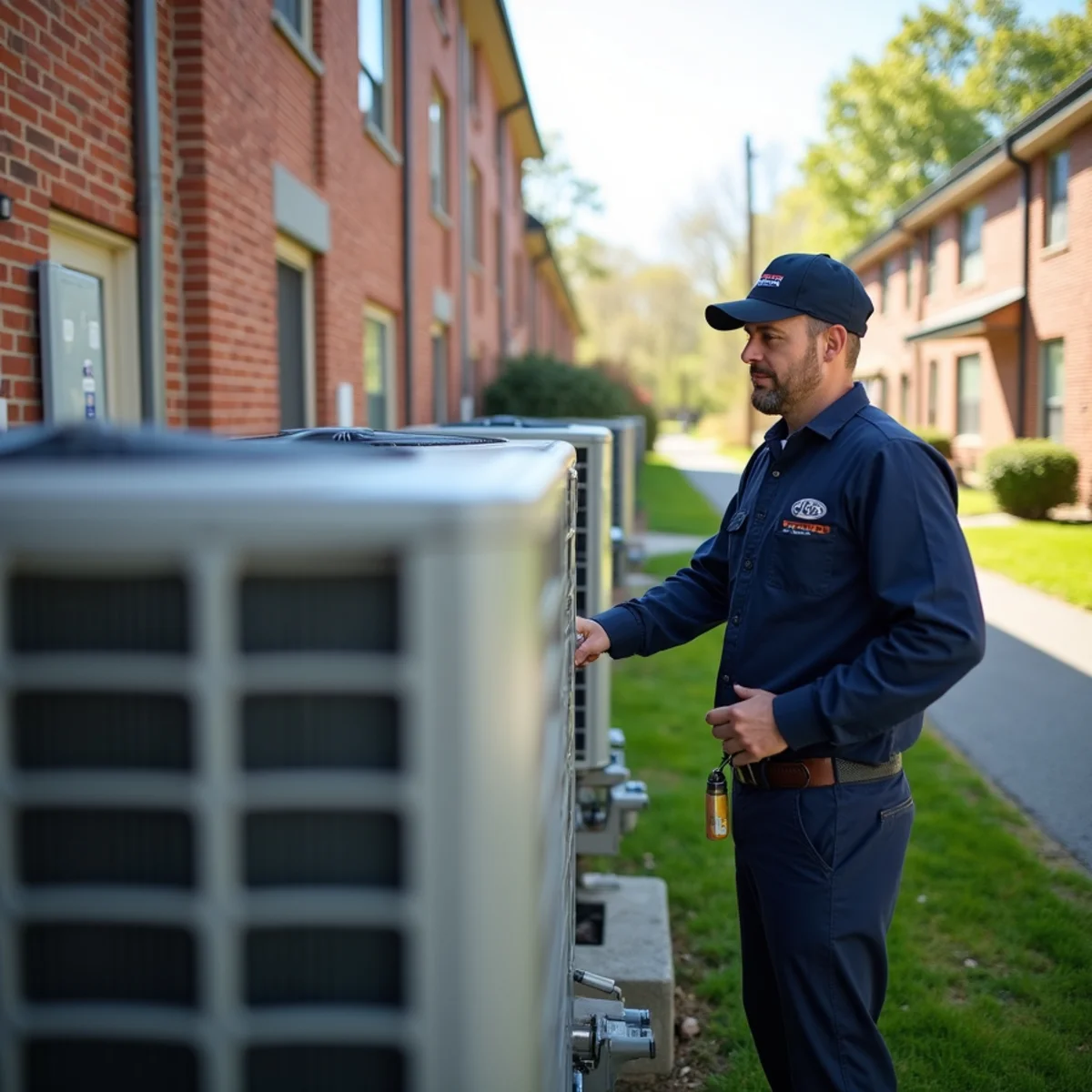
Rental HVAC fails differently than owner-occupied HVAC. The person feeling the discomfort is not the person paying for the repair, filters go unchanged for entire tenancies, units sit empty over winter break, and nobody notices a small problem until it is a large one.
Three practices address almost all of it.
Need this handled rather than explained?
Same-day emergency service across Cumberland County. Licensed technicians dispatched from Carlisle, with written options before any work begins.
Practice one: scheduled service on a calendar, not on request
The single biggest driver of rental HVAC emergencies is filters. Nobody changes them. Not because tenants are careless, but because it is not their equipment and often not their utility bill.
A loaded filter freezes an evaporator coil in July and trips a limit switch in January. Both produce a 9 p.m. call.
A landlord we work with in Shippensburg was running repeated mid-semester emergency calls across several converted properties. We put the portfolio on scheduled filter and drain service tied to fixed points in the academic calendar rather than to anyone’s memory. Emergency calls across the portfolio dropped substantially in the first year.
Practice two: freeze protection on every vacant unit
This is the one that prevents a five-figure loss, and it costs almost nothing.
A vacant unit with the thermostat set to 50°F "to save money" is a burst pipe waiting for one heating failure and one cold week. We have been called after the fact on exactly that scenario more than once — a heat pump failed over a winter break, nobody entered for days, and pipes let go on an exterior wall.
- Never below 55°F, and 58–60°F where plumbing runs in exterior walls
- A Wi-Fi thermostat with a low-temperature alert sent to your phone, not the tenant’s
- Condensate lines insulated, re-routed, or heat-traced before the first freeze
- A documented walkthrough before any extended vacancy
- Someone local with keys and instructions to check during extended cold
Practice three: document condition at every turnover
A between-tenants inspection with a written condition report does three things at once.
It finds the problems that will otherwise become mid-lease emergency calls. It gives you a dated record of equipment condition, which matters if a tenant later claims something was already broken or if you need to allocate a repair against a deposit. And it lets you plan replacements rather than react to them.
It is the cheapest twenty minutes in property management, and the one landlords skip most often.
Equipment choices that suit rentals
- Simple, serviceable equipment over feature-heavy systems. A tenant will not use a communicating thermostat’s features and it complicates every service call.
- Locking or limited-range thermostats where appropriate, which prevents both 82°F in January and 50°F setbacks that freeze pipes
- Filter cabinets rather than 1-inch slots where possible, so the interval is annual rather than monthly
- Float switches above any finished space — non-negotiable. A plugged drain in a rental with nobody watching is a ceiling.
- Condensers sited where they are not easy targets for damage or theft
- Standard equipment across a portfolio, so parts and familiarity carry from one unit to the next
Pennsylvania habitability, in practical terms
Pennsylvania recognizes an implied warranty of habitability in residential leases, and functioning heat is generally understood as part of it. Cooling is treated differently and is usually not required unless the lease provides for it.
The practical guidance: respond to heat complaints promptly and document your response. A written record of when a complaint was received, when a technician attended, what was found, and what was done protects both parties and resolves most disputes before they escalate.
This is general information rather than legal advice — consult an attorney for your specific situation and lease terms.
The multi-unit conversion problem
A large share of Carlisle and Shippensburg rentals are single-family houses converted into two, three, or four units. The HVAC almost never got properly reconfigured during the conversion.
What we find: one system split to serve multiple units with no way to meter or control them separately, thermostats located in whichever unit happened to have the wiring, ductwork sized for the original floor plan, and units where one tenant controls the temperature for everyone.
That last one generates more tenant disputes than anything else in a converted building. Where the layout allows, separate systems or ductless heads per unit eliminate the argument entirely — and they let you meter fairly, which changes tenant behavior on its own.
Filters in rentals: deciding who changes them and making it happen
Filter neglect causes more rental HVAC failures than any other single factor, and the reason is structural rather than personal: the tenant experiences none of the equipment cost and the landlord has no visibility of the filter.
Assigning the task in the lease is necessary and not sufficient. A clause saying the tenant will change filters monthly, with no filters provided and no check, produces exactly the outcome you would expect. The arrangements that actually work remove the friction or remove the reliance.
- Supply the filters — leave a labelled year supply of the correct size in the unit
- State the size and the interval in the lease, and in a note on the equipment itself
- Check the filter at every visit and photograph it, which builds a record over time
- Consider a deeper media cabinet, which extends the interval to months rather than weeks
- For multi-unit buildings, take the task in-house entirely and price it into the rent
- Never make it a deposit issue without having supplied the filters first
Handling a tenant no-heat call properly
A no-heat call is the moment a rental relationship is tested, and most of the disputes that follow come from the response rather than the fault. Two things matter: speed of acknowledgement and clarity of expectation.
Acknowledge immediately even if you cannot fix it immediately. A tenant who has been told a technician is booked for the morning is in a different position to one who has heard nothing, and the second becomes a complaint regardless of how quickly the repair eventually happens.
Habitability obligations in Pennsylvania are established through the implied warranty of habitability and any applicable local code rather than through a single simple rule, and how they apply depends on circumstances. Treat loss of heat in winter as urgent as a matter of course, and take specific legal advice on your own obligations rather than relying on general guidance.
- Acknowledge the report the same day, in writing, with what happens next
- Ask the diagnostic questions that speed the visit: make, model, code, what it does
- Have a contractor relationship in place before winter rather than searching on the night
- Give the contractor standing authority up to a value so nobody waits on you
- Consider temporary heating where a repair genuinely cannot happen quickly
- Record everything: report time, response, attendance, resolution
Related services and areas
Frequently asked questions
Generally no, unless your lease provides for it. Functioning heat is typically understood as part of the implied warranty of habitability; cooling is treated differently. That said, if the unit is advertised with air conditioning or the lease mentions it, you have created an obligation. This is general information — consult an attorney for your situation.
A locking or limited-range thermostat is the practical answer, set to a reasonable band. Where utilities are separately metered and the tenant pays, the incentive usually handles itself. Where you pay, a limited-range thermostat is a straightforward and defensible measure.
Set the thermostat no lower than 55°F, install a Wi-Fi thermostat with a low-temperature alert to your own phone, have condensate lines protected before winter, and arrange for someone to physically check the property during extended cold. It is the cheapest insurance available against a burst-pipe restoration.
It depends heavily on what your lease says, what you supplied, and what you can evidence, and it is worth taking legal advice before pursuing it. Practically, a claim is much stronger where the lease specified the task and the interval, where you provided the correct filters, where the equipment was documented as clean at move-in, and where you have dated photographs from inspections. It is much weaker where the tenant was told to change filters they had to source themselves for equipment they never saw. The reliable answer is to remove the reliance rather than to litigate it afterwards.
Loss of heat in winter is generally treated as an urgent condition, and the sensible operating standard is same-day acknowledgement and attendance as fast as you can arrange it. The precise legal position depends on the implied warranty of habitability, your lease and any applicable local code, and on the circumstances, so take advice on your own obligations rather than relying on a general figure. From a purely practical standpoint, the landlords who avoid disputes are the ones who respond immediately and document it, because a documented rapid response defuses almost every complaint that would otherwise follow.
Thermostat guards and limited-range controls are used in rentals, and they cut both ways. They do prevent a system being run at extremes, which protects equipment and, where heat is included in rent, controls cost. They also generate complaints, can create habitability arguments if the permitted range is set too narrowly, and tenants frequently defeat them. A more constructive approach in many buildings is a connected thermostat that gives you visibility and alerting without removing control, so you learn about a unit heated to eighty degrees or one that has stopped, and can address the cause.
Talk to a licensed Carlisle technician
HVAC Carlisle PA has served Carlisle and Cumberland County since 2007. We test before we recommend, we put options in writing, and we answer the phone at 2 a.m.
HVAC Carlisle PA · 122 Beech St, Carlisle, PA 17013 · +1 (327) 210-5999